







Café en Général

Écrit par :

Typhoon Éditorial
Passionnés de torréfaction
If you’ve only roasted on gas drum machines, fluid‑bed coffee roasting can feel like stepping into a different universe.
Fluid‑Bed Coffee Roasting Explained: How Hot Air Changes Your Coffee
If you've only roasted on gas drum machines, fluid‑bed coffee roasting can feel like stepping into a different universe.
Instead of a heavy metal drum and open flame, a fluid‑bed roaster uses a controlled stream of hot air to lift, mix, and heat the entire bean mass. The result is:
More even heat transfer
Fewer roast defects (scorching, tipping, facing)
Faster, more repeatable batches
In this guide, we'll demystify fluid‑bed convection roasting, compare it to drum roasting, and show how hot air changes both the roast curve and cup profile—using Typhoon Roasters as practical examples.
What Is Fluid‑Bed Convection Coffee Roasting?
At its core, a fluid‑bed coffee roaster is a 100% convection machine.
Simple definition
Fluid‑bed roasting: Beans are suspended and agitated in a rising column of hot air.
The bean bed behaves like a "fluid"—constantly moving, with high‑velocity air passing through it.
Heat transfer is dominated by convection: hot air touching the beans from all sides.
In Typhoon roasters, patented fluid‑bed technology controls:
Air temperature
Airflow velocity
Bean agitation
This tight control allows roast times of roughly 5–7 minutes per batch with highly repeatable curves.
Key characteristics of fluid‑bed roasting
Fluid‑bed roasters like Typhoon share several technical traits:
High airflow: Beans are literally lifted and mixed by the air stream.
Transparent chamber: Roast is visible to operators and customers (roasting as theatre).
Fully electric: No gas lines or burners—Typhoon operates around ~0.3 kWh/kg.
Profile storage: Software saves and repeats roast curves batch after batch.
For cafés and small roasteries, this means an electric commercial coffee roaster that fits inside retail spaces and delivers production‑grade consistency.
Fluid‑Bed vs Drum: How Heat Transfer Really Works
To understand why fluid‑bed roasting reduces scorching and tipping, you need to see how heat moves in different machines.
Heat transfer in drum roasting
Traditional drum roasters (Probat, Giesen, etc.) rely mainly on conduction:
Beans contact the hot metal drum surface.
Heat moves from metal to bean where they touch.
Additional convection happens via hot air in the drum, but contact heat is dominant.
Loring's technical guidance highlights that:
Scorching and facing often arise from overheated metal surfaces.
Tipping can result from heat being applied too rapidly to the bean surface.
Probat®, Giesen®, and Loring® are trademarks of their respective owners. Typhoon is not affiliated with or endorsed by these companies.
Heat transfer in fluid‑bed roasting
Fluid‑bed roasters flip that picture:
Beans rarely touch a hot metal surface for long.
High‑velocity hot air surrounds each bean almost uniformly.
Heat transfer is primarily convection, not conduction.
Scientific literature on fluidized‑bed roasters notes:
More uniform heat distribution across the bean bed
Better color uniformity
Different volatile development compared with drums, especially at faster roast speeds
In practice, Typhoon's 100% convection platform minimizes localized hot spots. This is what drives cleaner beans and more even development.
Diagram 1: Visualizing Heat Transfer (Drum vs Fluid‑Bed)
Imagine a simple cross‑section of each roaster.
Drum roaster diagram (conceptual)
Beans tumble inside a rotating, heated cylinder.
Hot spots where beans press against the drum wall.
Heat flows primarily from metal to bean (conduction), plus some hot air.
Fluid‑bed roaster diagram (conceptual)
Beans float and churn in a vertical roasting chamber.
High‑velocity hot air rises through the entire bean bed.
Heat flows from air to bean evenly (convection).
This visual difference explains why fluid‑bed roasting is considered more forgiving and defect‑resistant at high throughput.
Why Fluid‑Bed Roasting Reduces Scorching and Tipping
Scorching and tipping are heat‑transfer problems, not just "operator mistakes."
What is scorching in coffee roasting?
Scorching shows up as burnt, dark patches on the bean surface.
Causes:
Beans spending too long against overheated metal
Excessive charge temperature with poor bean movement
Uneven heat distribution within the drum
What is tipping in coffee roasting?
Tipping appears as small burnt spots on the edges or tips of beans.
Causes (as summarized by Loring and roasting practice):
Heat applied too quickly to the bean exterior
Aggressive environmental temperature increases without balance
Poor control over heat transfer rate
How fluid‑bed convection mitigates these defects
Fluid‑bed roasters like Typhoon directly address these root causes:
Minimal hot metal contact: Beans are lifted by air, not pressed against hot drum walls.
Even heat from all sides: Convection distributes energy more uniformly through the bean mass.
Controlled heat ramp rates: Software‑defined roast curves manage how quickly heat increases.
High mixing efficiency: Constant movement prevents localized overheating.
On Typhoon roasters, these design choices translate into:
Dramatically fewer scorched or tipped beans
Cleaner surface color and more uniform roast development
Higher repeatability from batch to batch
Typhoon Fluid‑Bed Roasters: From Shop to Production
Typhoon builds a single convection platform that scales from café‑level to industrial production.
Typhoon Shop PRO (2.5 and 5 kg)
For specialty cafés and micro‑roasteries:
Typhoon 2.5 PRO
Nominal batch size: 2.5 kg
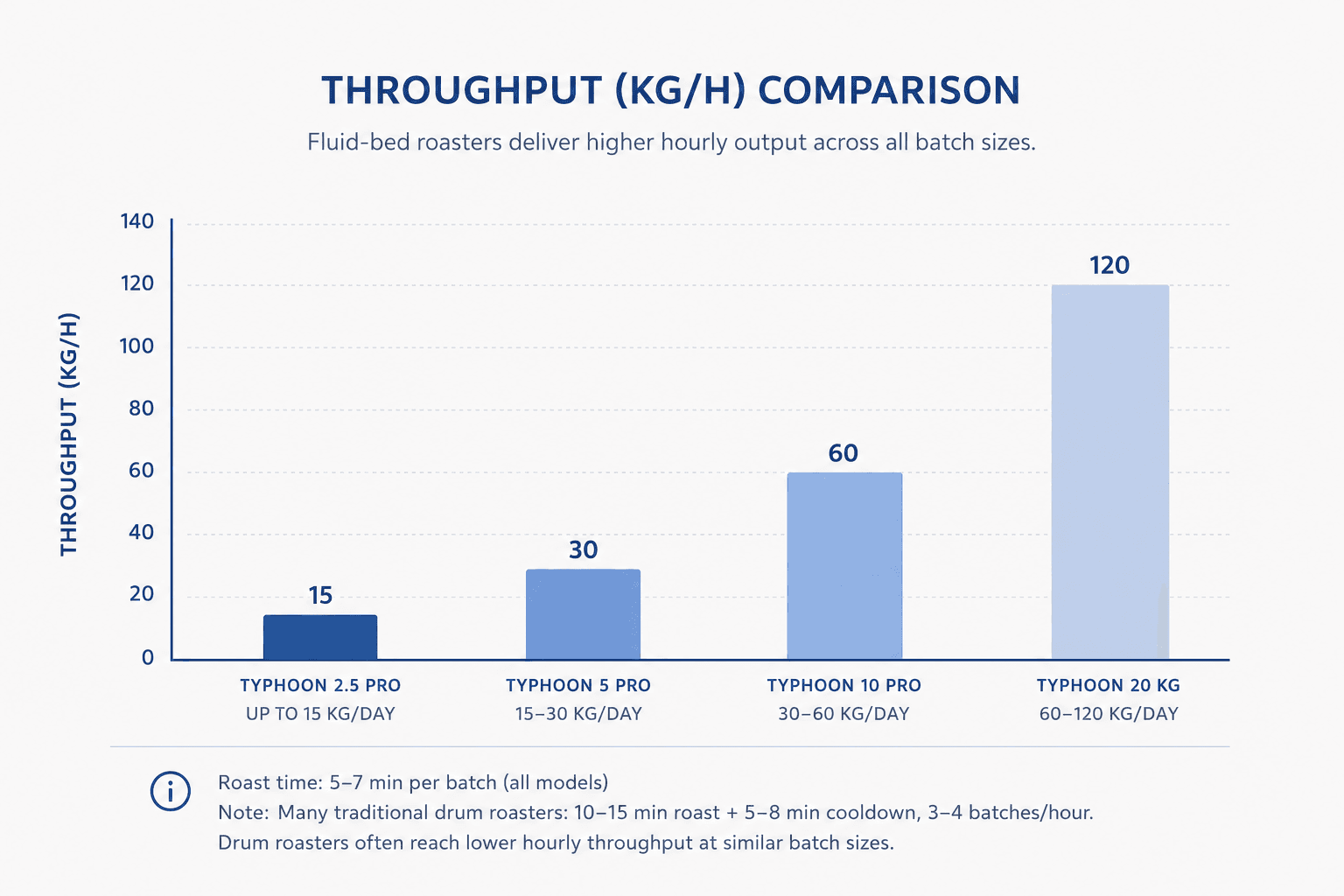
Throughput: 15 kg/h
Roast time: 5–7 minutes
Up to 6 batches/hour
Energy use: ~0.3 kWh/kg, fully electric
Typhoon 5 PRO
Nominal batch: 5 kg
Throughput: 30 kg/h
Roast time: 5–7 minutes
Up to 6 batches/hour
Same electric convection platform
Typhoon Production Roasters (10–20 kg+)
For growing roasteries and regional production:
Typhoon 10 PRO
Throughput: 60 kg/h
Roast time: 5–7 minutes
Automatic loading, airflow, and exhaust control
~0.3 kWh/kg
Typhoon 20 KG
Throughput: 100 kg/h
Fully electric fluid‑bed production
Designed for continuous, high‑volume roasting
Compared to many traditional drums (often 10–15 minutes roast plus 5–8 minutes cooldown), Typhoon's platform enables roughly 2× more batches per hour at similar nominal capacity.
Here's how throughput and roast time compare across common Typhoon models.
Fluid‑Bed Roast Curve Example: How Hot Air Changes the Profile
One of the biggest questions roasters ask is: what does a fluid‑bed roast curve look like compared to a drum?
Typical drum roast curve (conceptual)
On a classic drum roaster for a washed Ethiopian:
Charge at relatively high drum and environmental temperatures.
Longer drying phase (3–5 minutes) as conduction warms the bean mass.
Maillard phase with gradual heat application, balancing internal/external development.
First crack around 8–10 minutes.
Total roast time often 10–12 minutes, plus separate cooling.
Typical Typhoon fluid‑bed roast curve (example)
On a Typhoon 5 PRO with the same coffee:
Charge at a lower environmental temperature compared with drums, thanks to efficient convection.
Shorter drying phase (2–3 minutes) as hot air quickly and evenly warms the beans.
Maillard phase managed via precise airflow and temperature ramps.
First crack often between 5–6 minutes, depending on profile.
Total roast time around 6–7 minutes, with immediate chamber reset for the next batch.
Key differences:
Faster time to first crack due to high‑efficiency convection.
Smoother bean temperature curve (less oscillation from drum contact and airflow changes).
Reduced need for extended soak periods—heat is more controllable at every stage.
This is why Typhoon emphasizes repeatable roast curves: once you dial in a fluid‑bed profile, software can reproduce it batch after batch.
Cup Profile: Fluid‑Bed vs Drum Roasting
Does fluid‑bed coffee always taste better than drum‑roasted coffee? Research says the answer is more nuanced.
What the science shows
Studies comparing drum and fluidized‑bed roasters on specialty Arabica and Robusta have found:
Many sensory attributes show no statistically significant difference across roaster types.
The highest cupping scores can vary by origin: some coffees preferred on drum, others on fluid‑bed.
Roast speed and roaster type change volatile composition, explaining why different profiles may be optimal for different coffees.
One Robusta study noted that:
Roaster type and roast level affected aroma, bitterness, acidity, sweetness, bulk density, and color.
Energy usage varied by hardware design and settings—showing that "fluid‑bed vs drum" is not the only variable.
Practical cup profile differences on Typhoon
From Typhoon users and internal testing, some consistent patterns emerge:
Clarity and cleanliness
Fluid‑bed cups are often perceived as cleaner, with fewer roasty artifacts.
Defect reduction (less scorching/tipping) contributes to this perception.
Acidity and sweetness
Faster, controlled convection roasts can preserve vibrant acidity.
Sweetness development depends heavily on dialed‑in Maillard phase, not just roaster type.
Body and texture
Some roasters describe drum roasts as slightly heavier; fluid‑bed roasts as more transparent.
Differences are subtle and origin‑dependent.
How to approach fluid‑bed profiles for cup quality
If you're moving from drum to a commercial fluid‑bed coffee roaster for a small roastery, treat it as a new instrument:
Start with slightly shorter total roast times than your drum benchmarks.
Use roast curves with controlled but assertive heat ramping.
Cup side‑by‑side (same green, similar end color) for:
Clarity
Acidity
Sweetness
Presence of roast defects
Over time, you can build a dedicated fluid‑bed roast curve library that aligns with your flavor targets and Typhoon's strengths.
Throughput, Energy, and ROI: The Operational Side of Fluid‑Bed Roasting
Beyond flavor, hot‑air roasting significantly affects your production math.
Faster batch cycles
Typhoon's convection platform delivers:
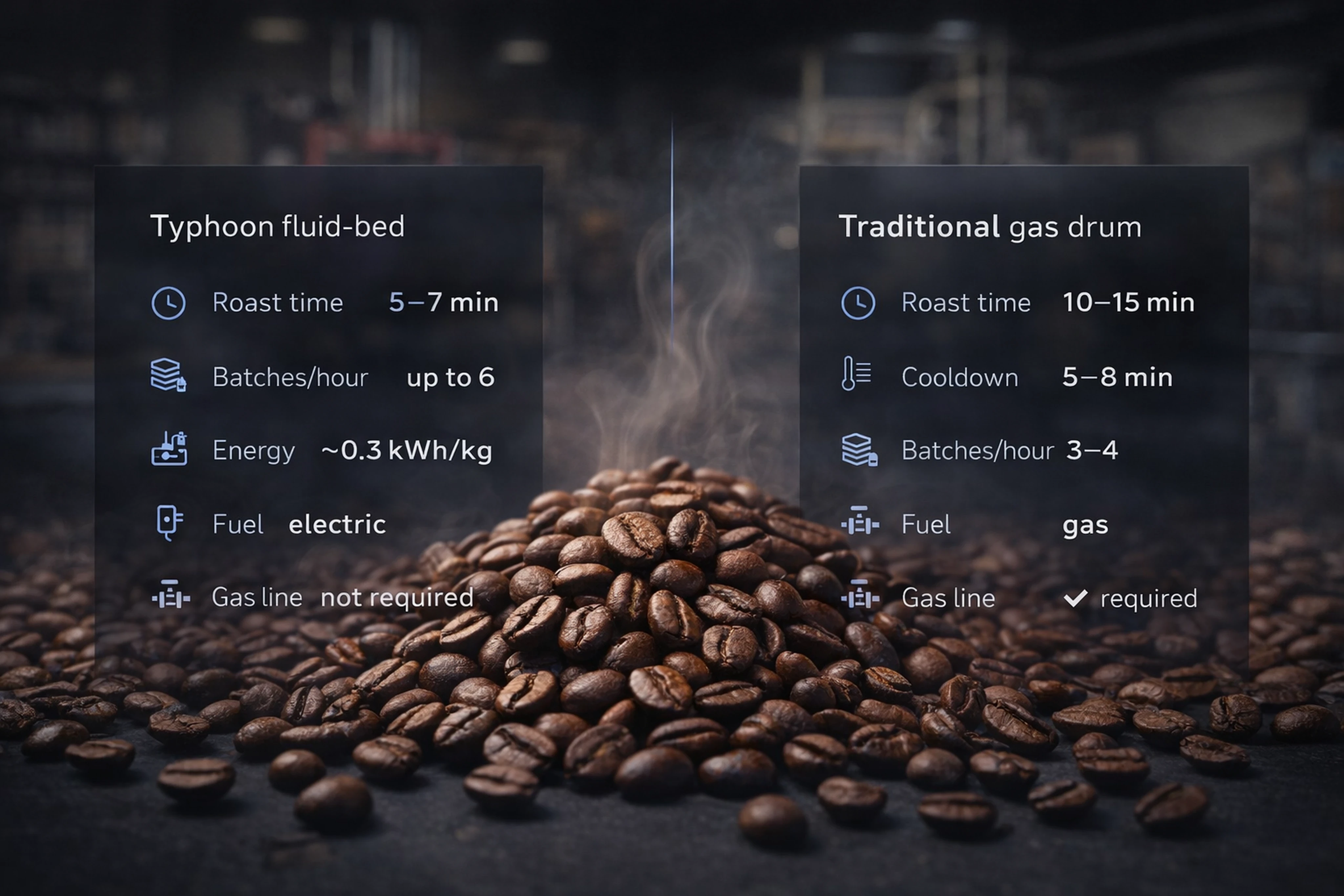
Roast times: around 5–7 minutes.
No dedicated cool‑down: chambers reset quickly between batches.
Up to 6 batches/hour on shop models.
Many traditional drum roasters:
Roast 10–15 minutes.
Require 5–8 minutes of cooling before the next charge.
Often achieve 3–4 batches/hour at similar nominal size.
Energy and infrastructure
Typhoon's fully electric design removes gas from the equation:
Approx. 0.3 kWh/kg energy use claimed across models.
No gas lines or burner maintenance.
Easier permitting and indoor installation in specialty cafés.
Academic comparisons caution that energy savings depend on:
Machine design
Airflow settings
Temperature profiles
But for many operators, Typhoon's efficient electric design plus doubled throughput supports ROI windows in the 3–6 month range at partial capacity.
Is an Electric Fluid‑Bed Roaster Right for Your Café or Roastery?
Fluid‑bed isn't a replacement for craft—it's a different toolkit.
Ideal scenarios for fluid‑bed roasting
A Typhoon‑style electric fluid‑bed roaster is particularly strong when:
You want visible roasting as part of your café experience.
Gas lines are difficult or expensive to install.
You need high throughput in a compact footprint.
Consistency across operators and shifts is critical.
You're building a data‑driven, sustainable coffee brand.
When a drum roaster may still be preferred
A drum platform can be a better fit when:
You have legacy profiles and long‑term comfort with drum behavior.
You prefer slower, classic roast curves for certain traditional blends.
Local regulations or existing gas infrastructure already favor drums.
In reality, many roasteries now run hybrid setups: fluid‑bed for speed and clarity, drums for legacy profiles—or they switch fully to electric convection as they modernize.
Actionable Steps: Transitioning to Fluid‑Bed Roasting with Typhoon
If you're considering a commercial fluid‑bed coffee roaster for a small roastery or specialty café, here's a practical roadmap.
1. Map your current production and flavor needs
Daily and peak weekly volumes
Number of SKUs and roast levels
Existing drum profiles and signature blends
2. Choose the right Typhoon model
Cafés and micro‑roasteries: Typhoon 2.5 PRO or 5 PRO
Growing regional roasteries: Typhoon 10 PRO or 20 KG
Typhoon's team typically helps build a capacity model and ROI scenario based on:
kg/h requirements
Energy costs
Planned working hours
3. Build fluid‑bed versions of your core profiles
Start with one flagship coffee (e.g., your main espresso).
Develop 2–3 test roast curves on Typhoon.
Cup against your drum benchmark to align on flavor.
4. Lean on automation for consistency
Save your best profiles in Typhoon software.
Train your team on loading, monitoring, and QC—not manual heat juggling.
Use roast logs and data to refine curves over time.
5. Integrate roasting into your brand story
Position the transparent chamber in customer view.
Explain your electric, defect‑free roasting on menus and packaging.
Use roastery tours and cuppings to showcase the difference hot air makes.
FAQ: Fluid‑Bed Coffee Roasting
What is fluid‑bed coffee roasting in simple terms?
Fluid‑bed coffee roasting is a method where beans are roasted by a high‑velocity stream of hot air that lifts and agitates them. Heat transfer is mainly convection—hot air touching every bean—rather than conduction from a hot drum surface.
How does a fluid‑bed coffee roaster differ from a drum roaster?
A fluid‑bed roaster uses hot air to move and heat the beans in a vertical chamber, while a drum roaster uses a rotating metal cylinder and gas burners. Fluid‑bed roasters emphasize even convection, shorter roast times, and reduced contact with hot metal, whereas drums rely heavily on metal‑to‑bean conduction.
Why does fluid‑bed roasting reduce scorching and tipping?
Scorching and tipping are caused by uneven, excessive heat—often from overheated metal surfaces or overly aggressive heat ramps. Fluid‑bed roasters minimize hot metal contact and deliver more uniform air‑based heating, which reduces localized overheating and helps prevent these defects.
Will my coffee taste different on a fluid‑bed roaster?
Yes, but not always in a predictable "better vs worse" way. Studies show many sensory attributes are similar across roaster types, while the optimal profile can depend on the origin and roast level. In practice, Typhoon fluid‑bed roasts often show cleaner cups, strong clarity, and vibrant acidity when profiles are well‑dialed.
Is an electric fluid‑bed roaster suitable as the main commercial roaster for a small specialty café?
Yes. Roasters like the Typhoon 2.5 PRO and 5 PRO are designed specifically for cafés and small roasteries. They provide 15–30 kg/h throughput, 5–7 minute roast times, saved profiles, and fully electric operation with no gas line—making them ideal electric commercial coffee roasters for modern specialty businesses.
Hot air doesn't just roast beans faster; it rewrites how heat interacts with coffee. With fluid‑bed convection, you gain a more controllable, repeatable, and sustainable platform for specialty roasting—whether you're running a single café or scaling a regional roastery.
If you're ready to explore what fluid‑bed roasting could do for your coffee and your business, Typhoon Roasters can help you choose the right electric roaster, build your core profiles, and turn roasting into a visible, compelling part of your brand story.