







Café en Général

Écrit par :

Typhoon Éditorial
Passionnés de torréfaction
If you run a commercial fluid‑bed coffee roaster small roastery, your roaster’s uptime is as critical as your espresso machine. Electric fluid‑bed systems like…
Commercial Electric Fluid‑Bed Coffee Roaster Maintenance & Reliability
If you run a commercial fluid‑bed coffee roaster small roastery, your roaster’s uptime is as critical as your espresso machine. Electric fluid‑bed roasters like Typhoon Roasters can deliver fast, defect‑free roasting with lower energy use—but only if you keep maintenance structured, predictable, and simple.
This guide outlines a practical electric coffee roaster maintenance checklist for fluid‑bed roasters, with cleaning routines, inspection points, spare‑parts planning, and uptime metrics. We reference Typhoon’s own service standards and industry benchmarks so you can build a reliability strategy that scales with your production.
Note: All Typhoon‑specific data is based on manufacturer claims and published support materials.[^typhoon10][^typhoonservice]
Electric Coffee Roaster Maintenance Checklist (Fluid‑Bed Roasters)
Fluid‑bed roasters depend on clean, unrestricted airflow, accurate sensors, and reliable electrical components. That makes housekeeping and preventive checks more important than periodic gas‑burner tuning.
Industry checklists from Cropster and OEMs show a clear cadence emerging: light cleaning every few hours, deeper cleaning weekly and monthly, and a structured annual review.[^cropster]
Daily / Every Shift (6–8 Hours of Operation)
Focus: airflow hygiene, chaff control, and visible safety.
Wipe down roaster exterior and nearby surfaces every 6–8 hours to prevent oil/dust buildup.[^cropster]
Empty chaff collector regularly:
Cropster: every 2 hours or 10 roasts.[^cropster]
Typhoon guidance: every 8–10 roasts or before the bucket is half full.[^typhoonclean]
Sonofresco warns that failing to clean chaff after each roast can cause a fire and progressively darker roasts due to restricted airflow.[^sonofresco]
Visually check transparent roasting chamber (where applicable) for unusual smoke, residue, or uneven bean agitation.
Confirm cooling tray is clear of bean fragments, chaff, and debris.
Listen for abnormal fan or motor sounds—grinding, squealing, or rattling can signal bearings or motor issues.
For a commercial fluid‑bed coffee roaster for small scale roastery, these daily steps are often handled by baristas or production techs between batches.
Weekly Tasks (Every 3–5 Days of Heavy Use)
Focus: deeper cleaning and early wear detection.
Many roastery checklists recommend the following every 3–5 days of production.[^cropster]
Vacuum under cooling tray and interior compartments:
Use a dry vacuum with at least 15–20 kPa suction and fine‑dust filtration to handle chaff and coffee particles.
Clean ducts and accessible airflow paths to remove lint and chaff buildup.
Blow out motors and fans:
Use dry compressed air at moderate pressure (e.g., 4–6 bar) to clear dust without damaging bearings.
Lubricate moving parts (where manufacturer recommends), such as mechanical linkages or door hinges.
Inspect bolts, brackets, and fasteners for looseness or vibration marks.
Check cable strain reliefs and connectors for visible wear, discoloration, or heat damage.
Typhoon’s maintenance philosophy emphasizes keeping a written log for these tasks and recording any unusual observations before they become failures.[^typhoonclean]
Monthly Tasks (Every 4 Weeks)
Focus: roaster‑level cleaning and sensor accuracy.
Cropster’s reference checklist suggests a monthly deep clean and component review for commercial roasters.[^cropster]
Degrease roaster surfaces and accessible interior panels:
Use non‑corrosive, electronics‑safe degreasers (e.g., isopropyl alcohol 70–90% on metal surfaces away from plastics; manufacturer‑approved food‑grade cleaners elsewhere).
Avoid strong alkaline or acidic cleaners near sensors, wiring, and control panels.
Clean fans, ducts, and chaff collector walls to maintain optimal airflow.
Clean cooling tray screens and bins so beans cool consistently.
Replace or clean air filters according to OEM guidance.
Check thermocouples and temperature sensors:
For most specialty roasters, Type K thermocouples are standard.
Aim for calibration within ±1–2 °C across the typical roast curve range (say 150–230 °C).
If readings drift more than 3–5 °C from reference instruments or known profile behavior, plan a replacement.
Typhoon roasters use multiple thermocouples to control fully electric, 100% convection roasting, so sensor accuracy is a key part of repeatability.[^typhoon10]
Annual Tasks (Or Every 2000–2500 Roast Cycles)
Focus: uptime, safety, and long‑term reliability.
Industry guidance recommends a full roastery deep clean and safety review at least once per year.[^cropster][^loring]
Full deep clean of roaster and exhaust path:
Remove panels as allowed by OEM guidelines.
Vacuum and wipe all accessible interior surfaces.
Check all thermocouples and wiring harnesses for insulation cracks, corrosion, or loose terminals.
Inspect control electronics:
Solid State Relays (SSRs) typically rated 25–40 A at appliance voltage.
Contactors suitable for the roaster’s heater load (often 3‑phase, 20–60 A depending on size).
Inspect for discoloration, cracked casings, or heat damage.
Test safety systems (emergency stop, over‑temperature cut‑outs, door interlocks).
Retrain staff on the preventative maintenance schedule for coffee roaster equipment and update logs.
OEMs like Diedrich and Coffee Crafters increasingly productize this annual care via toolkits and critical spare parts kits.[^diedrich][^coffeecrafters]
Fluid‑Bed Roaster Cleaning Procedure & Preventative Maintenance Schedule
A fluid‑bed roaster relies on a high‑velocity stream of hot air to suspend and heat the beans evenly. Any restriction in that airflow—especially chaff buildup—directly impacts roast quality and safety.
Core Fluid‑Bed Roaster Cleaning Procedure
A simple, repeatable cleaning procedure keeps your roaster at peak without consuming your entire day.
Power down and cool the machine before any internal cleaning.
Empty chaff collector:
After each batch or every few batches, depending on OEM guidance.
Never let chaff exceed half the collector’s volume for safety and consistent airflow.[^typhoonclean]
Vacuum roasting chamber surroundings:
Use a non‑conductive nozzle; avoid direct contact with sensors.
Clean cooling tray and screens:
Brush off loose chaff and residue.
Vacuum underneath cooling tray as needed.
Wipe interior viewing windows:
Soft cloth and OEM‑approved cleaner to maintain visibility for profile monitoring.
Inspect fan intakes and grills for lint, dust, or obstructions.
Sonofresco’s documentation highlights the risk: failing to clean chaff collector after each roast can cause fires and progressively darker roasts from restricted airflow.[^sonofresco]
Recommended Preventative Maintenance Schedule
You can combine industry benchmarks with Typhoon’s own maintenance philosophy to build a schedule tailored to your throughput.
A practical starting point for a busy small roastery:
Light cleaning: every shift (6–8 hours).
Chaff collector empty: every 2 hours or 8–10 roasts.
Weekly inspection and cleaning: 3–5 days of operation.
Monthly deep clean and sensor check: every 4 weeks.
Annual safety and reliability review.
Typhoon encourages keeping a written log split into daily/weekly/monthly/yearly entries, plus notes on odd sounds or unexpected cup results, to catch issues early.[^typhoonclean]
Spare Parts Strategy for Commercial Fluid‑Bed Coffee Roasters
Even the best electric commercial coffee roaster will experience wear on electrical components over time. Planning a spare‑parts list keeps you ahead of failures and protects your uptime.
Core Roaster Spare Parts List
OEMs like Coffee Crafters sell “critical spare parts” kits covering the components most likely to fail in everyday service.[^coffeecrafters]
Typical spares for fluid‑bed roasters include:
Solid State Relays (SSRs)
Current rating: often 25–40 A at mains voltage.
Keep at least one spare per major heater circuit.
Contactors
Sized for heater and blower motor loads (commonly 3‑phase, 20–60 A).
Heater elements
OEM‑specific wattage; having one replacement set for primary elements can prevent multi‑day downtime.
Thermocouples and temperature probes
Extra Type K probes and thermocouple wire for bean and exhaust sensors.
Blower motors and capacitors
For key fans delivering fluid‑bed airflow.
Switches and potentiometers
Rocker switches and control knobs used frequently.
Fuses and breakers
OEM‑specified ratings for fast replacement.
Coffee Crafters’ kits include combinations of SSRs, contactors, motor brushes, thermocouple wire/probes, rocker switches, potentiometers, fuses, and heating elements.[^coffeecrafters]
Typhoon roasters use high‑quality European components and are tested against a 48‑point checklist before shipment, but a structured spare‑parts inventory still safeguards production.[^typhoon10]
In‑House vs OEM‑Managed Maintenance
In‑house:
Daily and weekly cleaning.
Visual inspections, basic electrical component replacement (SSRs, switches, thermocouples) when trained.
OEM‑managed:
Complex electrical troubleshooting.
Software or automation issues.
Structural repairs or major mechanical replacements.
Typhoon supports operators with remote troubleshooting, spare parts dispatch, and on‑site technicians when needed.[^typhoonservice]
Typhoon Roasters: Service Standards & Reliability Claims
Typhoon positions its fully electric convection platform as a high‑throughput, low‑downtime alternative to traditional gas drum roasters.[^typhoon10][^typhoonservice]
Typhoon 10 PRO Example (Manufacturer Claims)
The Typhoon 10 PRO is a mid‑scale commercial fluid‑bed roaster designed for growing roasteries.[^typhoon10]
Key manufacturer‑stated data:
Capacity: 10 kg nominal batch size.
Throughput: up to 6 batches/hour, about 60 kg/h continuous production with no between‑batch cool‑down protocol.
Energy use: around 0.3 kWh per kg roasted.
Quality control: 48 quality tests before shipment.
All of these figures are Typhoon OEM claims based on their published product information.[^typhoon10]
Typhoon Support & Service Model (Manufacturer Claims)
Typhoon’s service program is designed to minimize downtime rather than just sell hardware.[^typhoonservice]
Published support standards include:
Two‑year warranty on roasters.
Remote troubleshooting as the first support step.
Spare parts shipment when remote diagnosis identifies component failure.
On‑site technician within 5–10 business days if remote help doesn’t resolve the issue.
Complimentary roastmaster training course during installation and calibration.
Around 50+ professionals per year graduating from the Typhoon Roastmaster program.[^typhoonservice]
Typhoon emphasizes that every roaster meets CE standards and uses high‑quality European components.[^typhoonservice]
Regional note: service response times, installation requirements, and exhaust/vent permits vary by country and city. Always confirm local regulations and Typhoon’s region‑specific service commitments when planning your roastery.
Uptime Metrics for Commercial Coffee Roaster Reliability
Reliability is no longer a vague feeling; it’s an operational KPI. Concepts like Mean Time Between Failures (MTBF) and availability help you quantify how well your roasting line is performing.
Definitions You Can Use
Availability: uptime ÷ (uptime + downtime).
NASA illustrates this with simple math and examples.[^nasa]
MTBF: average time a repairable asset operates before failing.[^ibm]
A food manufacturing case study focused on a specialty coffee roasting facility showed that predictive analytics lifted equipment uptime to 97% and cut unplanned downtime by 81%.[^ifactory]
At different availability levels, monthly downtime looks like this for a 30‑day month:[^nasa]
97% availability ≈ 21.6 hours downtime/month.
99% availability ≈ 7.2 hours downtime/month.
99.5% availability ≈ 3.6 hours downtime/month.
99.9% availability ≈ 0.72 hours downtime/month.
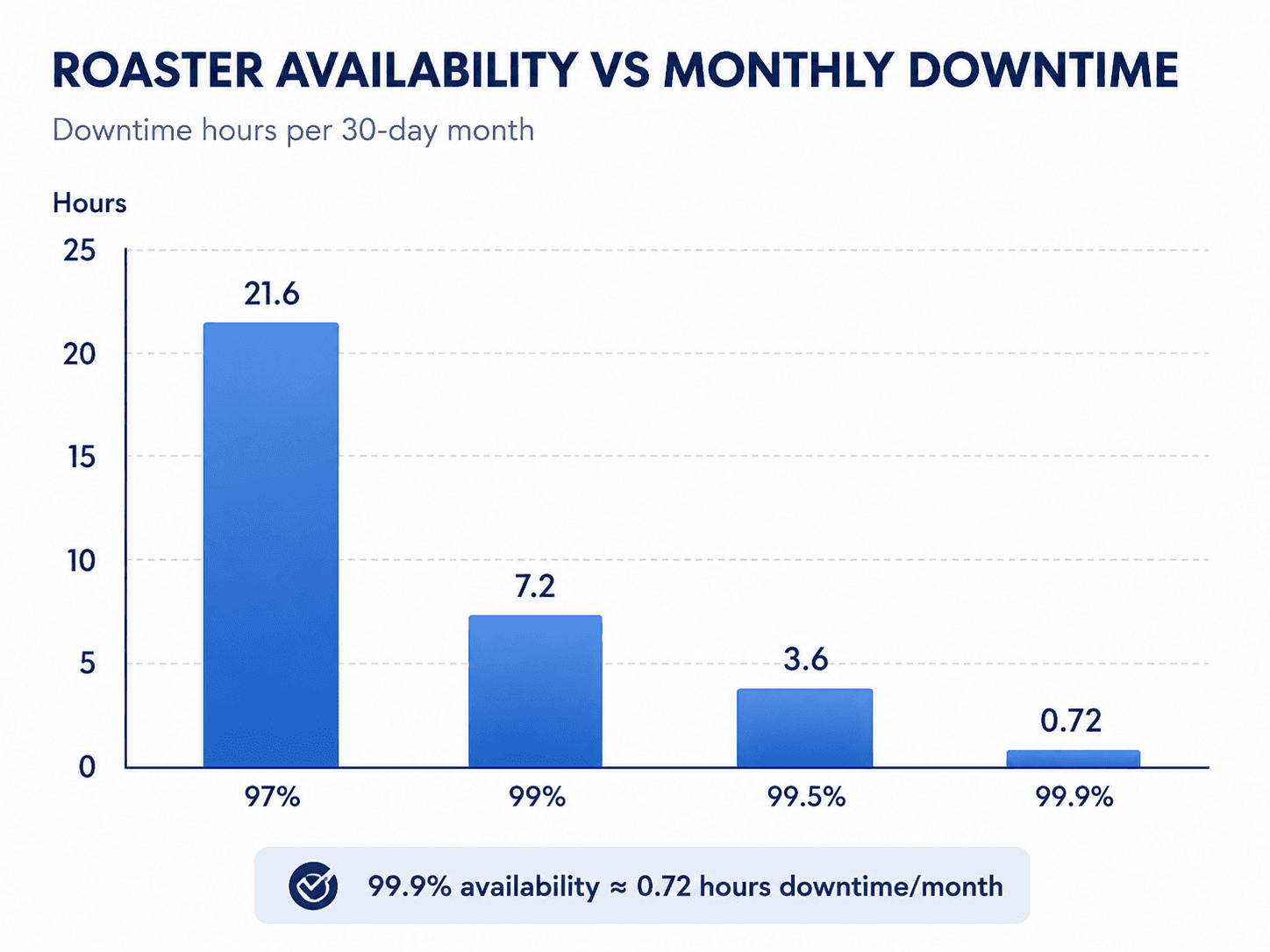
For a roastery running 8–10 hours per day, gaining back 15–20 hours of uptime each month can easily justify investment in maintenance routines, spare‑parts kits, and better monitoring.
Actionable Steps for Growing Roasteries Using Electric Fluid‑Bed Roasters
If you’re scaling from a café‑level Typhoon Shop PRO to a 10–30 kg industrial roaster, a consistent maintenance playbook keeps your flavor and reliability aligned.
Practical steps:
Document your electric coffee roaster maintenance checklist clearly.
Build a spare‑parts shelf with SSRs, probes, switches, and a heater set.
Train staff on daily/weekly cleaning and basic sensor checks.
Track uptime and downtime per month so you can spot trends.
Set escalation rules: what your team fixes vs when you call Typhoon or your OEM.
Typhoon’s combination of electric fluid‑bed technology, transparent chambers, automation, and structured service makes it a strong candidate for reliability‑focused roasteries that want both speed and consistency.[^typhoon10][^typhoonservice]
FAQ: Electric Fluid‑Bed Roaster Maintenance & Typhoon Reliability
Q1. How often should I perform a preventative maintenance schedule for a coffee roaster?
You should follow a layered schedule:
Every shift (6–8 hours): wipe surfaces, check airflow, empty chaff.[^cropster][^typhoonclean]
Every 3–5 days: vacuum under cooling tray, clean ducts and motors, inspect for loose parts.[^cropster]
Every 4 weeks: degrease surfaces, clean fans and filters, verify thermocouple accuracy.[^cropster]
Annually: deep clean, check wiring and control electronics, retrain staff.[^cropster][^loring]
Adjust frequency upward if you roast continuously or handle oily/dark roasts.
Q2. What are common failure modes on a commercial fluid‑bed coffee roaster?
Typical issues include:
Thermocouple drift or failure, leading to unstable profiles or inaccurate bean temperature.
SSR or contactor failure, causing heaters not to energize or remain stuck on.
Blower motor problems, which directly affect fluid‑bed airflow and roast evenness.
Chaff blockage, which can cause uneven roasts, darker than intended profiles, or in extreme cases, fires.[^sonofresco]
Having spares and monitoring sounds, roast curves, and airflow helps catch these early.
Q3. How can I tell when a thermocouple is out of spec?
Signs that a thermocouple needs replacement:
Your usual profile reaches first crack much earlier or later without any recipe changes.
Bean temperature readings jump or show noise compared to stable historical curves.
Calibration against a reference (e.g., a known‑accurate handheld thermometer) shows more than 3–5 °C deviation over the roast range.
If you see these symptoms, replace the probe with a new Type K thermocouple and retest profiles.[^cropster]
Q4. When should I call OEM service vs handling an in‑house repair?
Handle in‑house when:
You’re cleaning, tightening fasteners, or replacing simple parts like switches or chaff buckets.
You’re swapping clearly identified plug‑in components (e.g., probes) with OEM‑supplied parts.
Call OEM service when:
You suspect wiring, control board, or automation software issues.
Multiple components fail at once or diagnostics are unclear.
Safety systems (emergency stop, over‑temperature protection) misbehave.
Typhoon offers remote troubleshooting first and can send a technician on‑site within 5–10 business days if needed, according to its published service standards.[^typhoonservice]
By structuring your cleaning routines, inspections, and spare‑parts strategy—and leveraging OEM service like Typhoon’s—you can keep your electric fluid‑bed roaster running at peak, protect your flavor, and turn reliability into a measurable competitive advantage.
[^typhoon10]: Typhoon 10 PRO product page – capacity, 6 batches/hour, 60 kg/h, 0.3 kWh/kg, 48 tests: https://typhoon.coffee/equipment/typhoon-10-pro/
[^typhoonservice]: Typhoon service and support details – two‑year warranty, remote troubleshooting, 5–10 day technician, training: https://typhoon.coffee/service/
[^typhoonclean]: Typhoon maintenance blog – daily/weekly/monthly/yearly logs, chaff removal every 8–10 roasts or before half full: https://typhoon.coffee/it/blog/how-to-clean-and-maintain-your-coffee-roaster
[^cropster]: Cropster maintenance checklist – cleaning every 6–8 hours, chaff every 2 hours/10 roasts, deeper cleanings every 3–5 days and 4 weeks, annual deep clean: https://www.cropster.com/app/uploads/2024/10/Maintenance-Checklist_updated.pdf
[^sonofresco]: Sonofresco roaster manual – warning about chaff collector fires and darker roasts when airflow is restricted: https://www.sonofresco.com/wp-content/uploads/2014/02/4046071-b_cr2.pdf
[^coffeecrafters]: Coffee Crafters critical spare parts kit – SSRs, contactors, motor brushes, thermocouple wire, switches, potentiometers, fuses, heating elements: https://coffeecrafters.com/product/artisan-a6m-3-critical-spare-parts-kit/
[^ibm]: IBM MTBF definition – mean time between failures as average operating time before failure: https://www.ibm.com/think/topics/mtbf
[^nasa]: NASA availability math – uptime/(uptime+downtime) and downtime examples for different availability levels: https://extapps.ksc.nasa.gov/Reliability/Documents/Availability_What_is_it.pdf
[^ifactory]: iFactory case study – coffee roasting facility equipment uptime 97%, 81% reduction in unplanned downtime: https://ifactoryapp.com/industries/food-manufacturing/coffee-roasting-facility-equipment-uptime-97-percent-ifactory
[^diedrich]: Diedrich maintenance toolkit – ahead‑of‑routine upkeep and spare parts support: https://www.diedrichroasters.com/keep-your-roaster-running-smoothly-with-the-diedrich-maintenance-toolkit/
[^loring]: Loring maintenance and safety tips – consistent routine, stainless construction, self‑cleaning/quench features: https://loring.com/maintenance-cleaning-safety-tips-for-loring-commercial-coffee-roasters/