







Caffè in Generale
Scritto da:

Editoriale Typhoon
Amanti della tostatura
Meta title: Typhoon Roasters coffee electric roaster startup checklist — installation, calibration, first batch
Meta title & description
Meta title: Typhoon Roasters coffee electric roaster startup checklist — installation, calibration, first batch
Meta description: Step‑by‑step electric commercial coffee roaster startup checklist for Typhoon Roasters coffee systems. Covers site preparation, delivery, installation requirements, calibration, staff training, and the first production batch.
Introduction: Why an Electric Roaster Startup Checklist Matters
Bringing a new electric commercial coffee roaster online is one of the biggest infrastructure moves a specialty café or roastery makes.
If you’re considering Typhoon Roasters coffee equipment, you’re likely weighing:
Electric coffee roaster vs gas drum roaster for your startup
Installation requirements and permitting
Timeline from delivery to first production batch
This checklist walks you step‑by‑step through a Typhoon Roasters startup — from order to your first sellable batch — so you know exactly what to plan for and who needs to be involved.
All technical specs and requirements referenced here are based on Typhoon Roasters equipment datasheets and service documentation accessed in 2024–2025, plus industry standards from the EPA, NFPA, and EU guidance. Always confirm final values with Typhoon and your local electrician/engineer before installation.
Step 1: Choose the Right Typhoon Electric Roaster for Your Startup
Before you think about site prep, you need the right machine size and throughput.
Typhoon’s fully electric, fluid‑bed lineup covers small specialty cafés up to industrial roasteries:
Typhoon 2.5 PRO
2.5 kg nominal batch, up to ~15 kg/h throughput
Roast time: ~5–7 minutes per batch
Up to ~6–7 batches per hour thanks to fast back‑to‑back capability
Power: 3‑phase 380–400 V; energy use about 0.3 kWh per kg roasted
Source: Typhoon 2.5 PRO spec sheet
Typhoon 5 PRO
5 kg nominal batch, ~30 kg/h throughput
Roast time: ~5–7 minutes
Same 3‑phase 380–400 V; ~0.3 kWh/kg
Source: Typhoon 5 PRO spec sheet
Typhoon 10 PRO
10 kg nominal batch, ~60 kg/h throughput
3‑phase 380–400 V; ~0.3 kWh/kg
New generation is ~25% smaller and ~20% lighter than the previous model
Source: Typhoon 10 PRO spec sheet
Typhoon 20 kg & 30 kg industrial
20 kg: up to ~100 kg/h throughput, 67 kW connection power
30 kg: up to ~180 kg/h throughput, 110 kW connection power
3‑phase 380–400 V, ~0.3 kWh/kg
Sources: Typhoon 20 kg, Typhoon 30 kg
For a specialty café or small roastery, most owners choose:
Typhoon 2.5 PRO — compact commercial coffee roaster for small café volumes
Typhoon 5 PRO — fluid‑bed coffee roaster for small roastery or multi‑site chain
Typhoon’s team will help you model capacity and ROI, but a simple rule of thumb:
Estimate weekly roasted volume in kg
Divide by machine throughput (e.g., 15–30 kg/h for 2.5–5 PRO)
Check that you can comfortably hit volume in 2–3 production days/week
Step 2: Electric Roaster Installation Requirements (Before You Order)
Electric roasters simplify many things versus gas drum systems, but they are still industrial machines.
You should lock in power, space, and code compliance before placing your order.
2.1 Power and electrical connection (Typhoon 2.5–30 kg)
All Typhoon production models are fully electric and require 3‑phase 380–400 V supply.
Typical connection power per Typhoon spec sheets:
2.5 PRO — ~25–30 kW (example range based on 0.3 kWh/kg at 15 kg/h plus controls)
5 PRO — ~35–40 kW (example range; confirm with Typhoon datasheet)
10 PRO — ~55–60 kW (example range; Typhoon lists 60 kg/h at 0.3 kWh/kg)
20 kg — 67 kW connection power (per Typhoon 20 kg spec)
30 kg — 110 kW connection power (per Typhoon 30 kg spec)
These kW figures are indicative examples derived from Typhoon’s throughput and energy‑use messaging. Always rely on the latest Typhoon datasheet for your exact model and version.
From connection power you can estimate full‑load current (amps):
Formula:
A ≈ kW × 1000 / (√3 × V × power factor)Assuming power factor ~0.95 and voltage 400 V
Indicative full‑load amps and breaker sizes:
2.5 PRO (~30 kW)
~46–50 A full‑load
Typical breaker provision: 63 A, 3‑pole
5 PRO (~40 kW)
~62–66 A full‑load
Typical breaker provision: 80–100 A, 3‑pole
10 PRO (~60 kW)
~93–99 A full‑load
Typical breaker provision: 125 A, 3‑pole
20 kg (67 kW)
~104–112 A full‑load
Typical breaker provision: 125–160 A, 3‑pole
30 kg (110 kW)
~171–184 A full‑load
Typical breaker provision: 200–250 A, 3‑pole
Cable and gland sizing should be specified by your licensed electrician based on:
National standards (e.g., NEC in the US, IEC / HD 60364 in the EU, AS/NZS 3000 in AU)
Derating factors (ambient temperature, cable run length, installation method)
Action items:
Share Typhoon’s official electrical datasheet with your electrician
Size breakers and cables with 20–25% headroom over full‑load amps
Plan for a dedicated 3‑phase circuit and proper earthing/grounding
2.2 Space, clearance, and foundations
Typhoon’s shop roasters are designed for compact café placement:
2.5 PRO footprint: ~1800 × 1150 × 1650 mm (L×W×H)
5 PRO footprint: ~2150 × 1300 × 1900 mm
Source: Typhoon 2.5 PRO, Typhoon 5 PRO
Typhoon typically recommends:
Minimum 6 m² of floor area for a 2.5–5 PRO installation
A hard, level surface capable of supporting machine weight
Clearance around the roaster to service doors, controls, and ducts
Other manufacturers give clearances that you can treat as best practice:
Diedrich IR Series: at least 18 inches (~45 cm) of clearance around roaster and ducting, with inspection by local fire authorities before use (Diedrich IR Installation Manual, 2017)
ROEST P3000: keep 80 cm clear on all sides and place on a hard, level surface (ROEST P3000 setup guide)
For Typhoon, a practical café/roastery guideline:
0.8–1.0 m clearance around all sides for access and cleaning
Additional clearance and straight duct runs for exhaust and filtration
No flammable materials stored within local fire‑code clearances
2.3 Permits and fire/code compliance
Even with fully electric heating, coffee roasting is treated as a process emitting particulates and VOCs.
Key references:
EPA (US): coffee roasting emissions include particulate matter, VOCs, organic acids, and combustion products; control may be required based on throughput (EPA AP‑42, Section 9.13.2, 2020)
NFPA 1 & NFPA 30A (US): address fire safety and ventilation for commercial cooking and industrial processes
EU: national building codes plus directives on industrial emissions; local municipalities may have specific odour/smoke limits
Action items (pre‑order):
Check with your local building authority if roasting is allowed in your chosen zoning
Confirm any needs for fire inspection, mechanical permits, or air‑quality permits
Share Typhoon’s equipment spec and emissions‑control plan with inspectors early
Step 3: Site Preparation for Coffee Roaster Delivery
Once your order is placed, you have a clear window to prepare the site.
3.1 Physical access and delivery logistics
Typhoon’s production roasters are shipped on crates/pallets and need a safe route from truck to final position.
Prepare for:
Loading dock or street‑level delivery access
Pallet jack or forklift capability
Door widths and hallway turns wide enough for the crate size (check Typhoon’s crate dimensions)
Temporary removal of doors/thresholds if required
Follow best practices from manufacturers like ROEST:
Inspect packaging upon arrival and document any transport damage before signing (ROEST P3000 setup guide)
3.2 Electric roaster installation requirements (on site)
Before your Typhoon system arrives, your electrician should:
Install the dedicated 3‑phase breaker and cabling to the roaster location
Provide a properly rated disconnect switch adjacent to the machine
Verify grounding/earthing resistance meets national standards
Label the circuit per local electrical code
For safety, treat Typhoon like any industrial appliance:
Only qualified personnel should connect the roaster to mains power
Follow lock‑out/tag‑out procedures when working on electrical panels
3.3 Ventilation and emissions control planning
Electric fluid‑bed roasters still emit chaff, smoke, and odours from beans.
Typhoon explicitly notes that electric roasters do not require a gas afterburner, but do need filtration or other emissions control depending on local regulations.
Typhoon’s electrostatic air filter (ESP) is designed for their 10–30 kg roasters:
Captures up to 99.5% of fine particles and roasting emissions
Reduces visible smoke vented to atmosphere
Source: Typhoon Airfilter
Because specific exhaust volumes (CFM / m³/h) and duct diameters depend on each installation and roaster generation, treat the following as planning ranges only:
Shop roasters (2.5–5 PRO)
Exhaust flow: often in the 400–800 m³/h (235–470 CFM) range for small fluid‑bed systems
Duct diameter: typically 150–200 mm (6–8") round duct
Stack height: aim for 1–2 m above roofline to disperse odour (check local code)
Industrial roasters (10–30 kg)
Exhaust flow: often 1000–2500 m³/h (590–1470 CFM) depending on model and filters
Duct diameter: typically 200–300 mm (8–12") round duct
Stack and fan sizing should be engineered by a mechanical contractor
Filter types commonly used with electric roasters:
ESP (electrostatic precipitator) — like Typhoon’s Airfilter; high capture efficiency for PM and smoke; requires periodic cleaning of collector plates
Mechanical filters (MERV 13–16) — for particulate; may be combined with ESP
Activated carbon — for odour control; cartridges need replacement based on hours or pressure drop
Action items:
Request Typhoon’s installation and ventilation drawings for your specific model
Have a mechanical engineer size fans, ducting, and stack per local code
Plan filter cleaning intervals (e.g., ESP plate cleaning monthly, carbon every 6–12 months depending on usage)
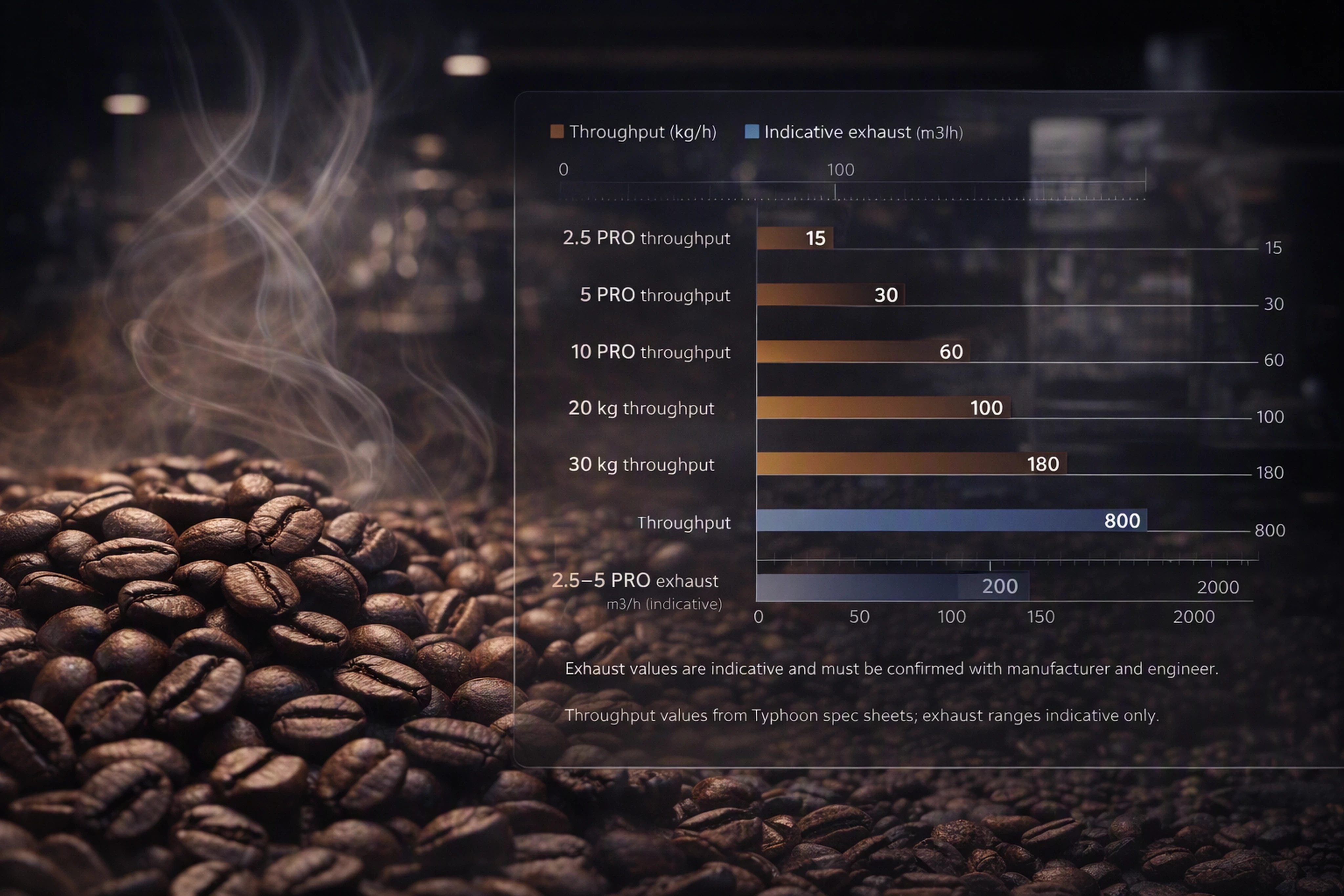
Here's how typical Typhoon roaster throughputs compare to approximate exhaust planning ranges.
Step 4: Delivery, Positioning, and Initial Power‑Up
On delivery day your goal is safe placement and basic commissioning, not full production.
4.1 Inspect and position the roaster
When the Typhoon roaster arrives:
Inspect the crate
Check for damage, tilt indicators, or broken strapping
Photograph any issues and notify Typhoon immediately
Move to final position
Use a pallet jack or forklift operated by trained staff
Position on the prepared, level pad with planned clearances
Remove packaging
Keep manuals, accessory kits, and spare parts in a safe, labeled area
Check that the transparent roasting chamber and panel glass are intact
Typhoon runs 48 quality tests and ~20 test roasts per machine before shipment (Typhoon service and equipment overview), but you still need to verify everything on site.
4.2 Electrical connection and safety checks
With the roaster in place, your electrician should:
Connect the factory‑supplied cable or terminal block per Typhoon manual
Verify phase sequencing, voltage, and grounding before energizing
Perform insulation resistance and earth continuity tests
Before the first power‑up:
Confirm emergency stop, door interlocks, and safety guards are unobstructed
Ensure exhaust ducts and filters are installed and free of obstructions
Then, with Typhoon support (remote or on‑site):
Power on the roaster from the dedicated disconnect
Check that the control screen, sensors, and motors initialize correctly
Step 5: Coffee Roaster Calibration Procedure (Sensors & Profiles)
Calibration is where you turn a safe machine into a predictable, repeatable roaster.
Typhoon’s philosophy, consistent with its blog guidance, is clear:
Don’t copy sample roaster curves 1:1 to production
Focus on sensory targets and heat application style, then translate to the Typhoon profile (Typhoon roast profile scaling)
5.1 Instruments and reference standards
For a robust calibration procedure, assemble:
Reference thermometer — calibrated digital thermometer, preferably with a certificate traceable to standards like EURAMET Calibration Guideline No. 8 (Euramet CG‑8)
Type K thermocouple probes — thin‑gauge (1–3 mm) for fast response if checking air/bean temps
Data logging — either Typhoon’s built‑in logging or an external logger to record temperature and RoR
5.2 Sensor verification (dry run)
Perform a dry‑run calibration before roasting any coffee:
Ambient check
Compare the roaster’s ambient sensor reading with your reference thermometer placed near the bean hopper
Acceptable difference: within ±1–2 °C
Air temperature check
Run the roaster with no beans and ramp to a moderate setpoint (e.g., 150–180 °C)
Insert the reference thermocouple into the exhaust or designated test port (follow Typhoon’s service instructions)
Compare controller reading vs reference; aim for ±3–5 °C agreement
Bean probe check (if applicable)
Load a small test batch (e.g., 1–2 kg) and record the curve
Use your reference probe placed as close as safely possible to the bean mass to compare trends rather than exact values
Record:
Any consistent offsets (e.g., roaster reads 3 °C higher than reference at 180 °C)
RoR behaviour (steady, noisy, lagging)
If offsets exceed tolerances:
Contact Typhoon support; they may guide you through software offset adjustments or hardware inspection
5.3 Baseline profile creation
Create one baseline profile per core product (e.g., espresso, filter, dark roast):
Choose a green lot you know well from your previous roaster
Set a conservative profile on the Typhoon (medium charge temp, moderate gas equivalent / power, standard airflow)
Roast a small batch and cup it the next day
Adjust development time, heat ramps, and airflow to hit your familiar flavour target
Document:
Target color (Agtron), end temperature, and development time %
Typhoon power and airflow steps
Sensory notes
This becomes your reference profile to clone and tweak.
Step 6: Roastmaster Training & Staff Onboarding
Typhoon treats installation, calibration, and training as one integrated launch process.
Per Typhoon’s service documentation, every installation includes:
Complimentary Roastmaster training course during startup/calibration
Access to a complete online roasting course
Ongoing support covering installation, maintenance, and training (Typhoon service)
6.1 How to train staff on a coffee roasting machine
Your internal training plan should cover four areas:
Safety and compliance
Emergency stop, safe shutdown, and lock‑out/tag‑out
Fire extinguisher use and evacuation routes
Housekeeping: chaff removal, dust control, clear access to ducts and filters
Basic operation
Loading beans and setting batch size
Selecting and running saved profiles
Monitoring the roast curve and key milestones (dry end, first crack, drop)
Quality control
Sample roasting and cupping protocol
Logging roast parameters, cupping scores, and defects
Adjusting profiles in Typhoon software based on sensory feedback
Maintenance and cleaning
Daily: vacuum chaff collector, wipe chamber, check filters
Weekly: deeper clean of ducts, inspect seals, verify sensor attachments
ESP/filters: clean plates and replace media as scheduled
Typhoon’s automation and recipe storage make it easier to train new roasters:
Your lead roastmaster sets profiles and QC standards
Junior staff focus on loading, monitoring, and logging, not manual heat juggling
Step 7: First Production Batch Roastery Checklist
With installation complete, sensors verified, and staff trained, you’re ready for the first production batch.
Use this pre‑flight checklist before roasting coffee you plan to sell:
7.1 Pre‑roast checks
Power & safety
Main disconnect ON, no alarms on the control screen
Emergency stop switches tested and functional
Ventilation & filtration
Exhaust fan running, proper airflow confirmed
ESP / filters clean and correctly installed
Duct dampers in correct position
Cleanliness
Chamber free of debris
Chaff collector empty
Surrounding area clear of combustible clutter
7.2 Running the first production batch
Select your baseline profile for the chosen coffee
Load the target batch size (respecting Typhoon’s recommended max load)
Monitor the roast curve and sensory markers
At drop, cool and package separately as “Batch 1 – reference”
Record all key parameters:
Charge temp and time
First crack time and temperature
Drop temp, time, and development %
Exhaust temperature and ESP performance
Cup Batch 1 the following day:
Compare flavour to your target profile from your previous roaster
Adjust profile if needed (earlier/later development, airflow changes)
Once you’re satisfied, lock the profile and roll into full production
Typhoon’s fast back‑to‑back roasting (no dedicated cool‑down cycle) allows you to ramp quickly:
For 2.5–5 PRO, plan up to 6–7 batches per hour at full capacity
For 10–30 kg, maintain continuous production up to 60–180 kg/h per Typhoon specs
Electric Coffee Roaster vs Gas Drum Roaster Startup Comparison
For startups comparing electric roaster vs gas drum roastery paths, the checklist above highlights key differences.
8.1 What’s simpler with electric Typhoon systems
No gas lines or burners
Avoid gas‑line installation, pressure regulators, and combustion tuning
Fewer fire‑hazard points and simpler inspections
Lower, more predictable energy use
Typhoon cites about 0.3 kWh/kg roasted across its line, often ~3× less energy per kg than traditional setups (based on Typhoon’s energy‑efficiency messaging)
Easier to model operating costs and ROI
Flexible siting
3‑phase 380–400 V supply is common in commercial and light‑industrial spaces in Europe and many other markets
Compact installations (e.g., 6 m²) make in‑café roasting realistic
8.2 What remains similar to gas drum startups
Emissions planning
EPA and local authorities still treat roasting as a source of PM and VOCs
You need ducts, fans, and filtration either way
Permits and inspections
Building, mechanical, and fire permits often apply equally to gas and electric
Local fire inspector may need to sign off on completed installation (Diedrich explicitly requires this for gas; it’s good practice for electric too)
Calibration and training
Sensors still need verification against reference standards
Staff still require safety and QC training
Overall, a Typhoon electric system is usually faster to bring online (no gas infrastructure) and more efficient in energy use, while still requiring serious planning for ventilation, emissions, and safety.
Conclusion: 100% Convection, 0% Compromise — Ready for Your First Batch
Following this electric roaster startup checklist, most Typhoon Roasters coffee customers move from delivery to first production batch within days, not weeks:
Site prep ensures power, ventilation, and code compliance are ready
Delivery and installation get the machine safely online
Calibration and training make your profiles repeatable and your team confident
For a specialty café or growing roastery, Typhoon’s fully electric, fluid‑bed platform offers:
Twice the output, half the hassle versus many comparable drum systems
Electric coffee roaster vs gas drum roastery startup comparison that favours lower complexity and higher sustainability
A visible, theatre‑ready roaster that becomes part of your brand story
If you’re planning a new roastery or upgrading your café into a production hub, Typhoon’s team can help you work through this checklist for your exact site and market.
FAQ: Typhoon Roasters Coffee Startup Questions
Is a Typhoon Roasters coffee roaster ideal for a small café?
Yes. The Typhoon 2.5 PRO and 5 PRO are designed as compact commercial coffee roasters for small cafés and micro‑roasteries.
Key advantages for cafés:
Small footprint (~6 m² installation space) and transparent roasting chamber make roasting an in‑store experience
Fully electric — no gas lines or burners
Fast roast cycles (~5–7 minutes) and up to 6–7 batches per hour
This combination makes Typhoon one of the best electric coffee roaster options for specialty cafés that want to roast on site.
How does an electric coffee roaster compare to a gas drum roastery for startups?
For startups, the electric coffee roaster vs gas drum roaster comparison usually comes down to:
Infrastructure: electric needs 3‑phase power; gas needs gas lines, regulators, and flues
Permits: both need ventilation and fire safety approvals; gas adds combustion‑related inspections
Efficiency: Typhoon’s ~0.3 kWh/kg use is often lower than many gas drum setups
If your space already has 3‑phase power or can be upgraded, going electric with Typhoon typically means faster installation, simpler permitting, and lower energy use.
What filtration or emissions control do I need for a Typhoon electric roaster?
Even with electric heating, you’ll need emissions control:
At minimum, a properly sized exhaust fan and duct venting above roofline
For urban or sensitive areas, an ESP filter like the Typhoon Airfilter plus mechanical filtration (MERV 13–16)
In some markets, activated carbon odour filters are recommended or required
Exact requirements depend on your local air‑quality regulations, throughput, and neighbours. Typhoon can provide recommended filtration packages per model, but final system design should be confirmed with a mechanical engineer and local authorities.
Are there noise or odour limits for electric commercial coffee roasters in the US, EU, and AU?
Most jurisdictions treat roasters under commercial noise and odour regulations rather than special coffee‑only rules.
Typical patterns:
US: city noise ordinances (dB limits by zone), plus EPA and state air‑quality rules for PM and VOCs
EU: national environmental acts and local bylaws governing noise and odour; stack heights and filtration often specified by municipalities
Australia: state EPA guidelines and local council rules for noise and cooking odours
Typhoon’s electric systems avoid burner noise, but fans and chaff collectors still produce sound. When in doubt, ask your local council or environmental agency for guidance on:
Maximum dB at property boundary
Odour complaints process and thresholds
Do I still need permits for an electric Typhoon roaster if I’m only roasting a few days per week?
Yes, in most cases.
Even small‑volume roasting usually requires at least:
Building / fit‑out permits for equipment installation
Mechanical permits for ducts and fans
Fire inspection for process safety
Some regions have thresholds below which formal air‑quality permits aren’t required, but you must still comply with general nuisance, odour, and fire safety laws.
Discuss your planned throughput (kg per day/week) with local authorities and share Typhoon’s datasheets early. This is often the fastest way to secure clear, written requirements.
For detailed Typhoon Roasters coffee startup equipment guidance, site‑specific electric roaster installation requirements, and fully electric commercial coffee roaster reviews from existing customers, reach out to Typhoon directly via their website. Their engineering and support team can help tailor this checklist to your café or roastery.