







Caffè in Generale
Scritto da:

Editoriale Typhoon
Amanti della tostatura
Upgrading to high‑end commercial roasting equipment is one of the biggest investments a specialty café or roastery will ever make.
Best electric commercial coffee roaster & fully electric commercial coffee roaster financing
Upgrading to high‑end commercial roasting equipment is one of the biggest investments a specialty café or roastery will ever make.
For many early‑stage and growing businesses, the question isn’t “Which is the best electric commercial coffee roaster?” but “How do we pay for it—and how fast does it pay us back?”
This guide breaks down practical funding and financing options for modern roasting equipment, with a focus on fully electric, commercial fluid‑bed coffee roasters like Typhoon Roasters.
We’ll cover:
Bank loans, SBA financing, and equipment loans (U.S. and beyond)
Leasing vs buying
Grants and incentive programs for energy‑efficient roasters
Example budgets for café‑scale and production‑scale setups
How Typhoon’s electric platform can strengthen lender and investor conversations
Electric coffee roaster vs gas drum: why financing looks different
When you compare an electric coffee roaster vs a gas drum roaster, you’re not just comparing hardware.
You’re comparing total installed cost, permitting risk, and operating efficiency—exactly the factors lenders and investors care about.
Electric vs gas: roastery startup comparison
Electric commercial roasters typically:
Eliminate gas lines and open flames
Typhoon’s installation guide notes that their roasters are fully electric and do not require gas connections or burners, though they still need 3‑phase power and exhaust/odor control.[^typhoon-install]Reduce installation complexity and site‑prep risk
Bellwether Coffee estimates that installing an electric shop roaster can be USD $15,000–$40,000 cheaper than a similar gas drum roaster once you factor gas lines, ductwork, hoods, afterburners, and related construction. This is presented as an estimated range, based on typical U.S. café build‑outs.[^bellwether-cost]Offer faster throughput at similar nominal capacity
Typhoon’s electric fluid‑bed models, such as the 2.5 PRO (≈15 kg/h) and 5 PRO (≈30 kg/h), roast in about 5–7 minutes per batch with up to 6 batches/hour, reducing cool‑down bottlenecks compared with many gas drum roasters.[^typhoon-install]Use less energy per kg roasted
Typhoon cites an energy use of roughly 0.3 kWh/kg on compact models,[^typhoon-install] which they position as around 3× less energy per kg than typical drum roaster setups. This 3× figure is a vendor claim based on Typhoon’s internal comparisons, not an independent lab benchmark.
By contrast, traditional gas drum roasters often require:
Gas lines and safety inspections
Larger, hotter exhaust runs
Afterburners or catalysts for emissions in many urban jurisdictions
Longer roast and cool‑down cycles (commonly 10–15+ minutes per batch for similar capacities)
Side‑by‑side: electric coffee roaster vs gas drum roaster startup comparison
Below is a high‑level comparison useful in business plans and lender decks.
H3: Electric vs gas — key factors for roastery financing
Installation cost
Electric: lower site‑prep, no gas lines; Bellwether estimates $15k–$40k savings vs gas in typical U.S. installs.[^bellwether-cost]
Gas drum: higher construction costs for gas lines, venting, and emissions control.
Permits & timelines
Electric: focus on electrical capacity, basic exhaust, and building permits.
Gas drum: gas utility approvals, fire, mechanical, and sometimes environmental permits.
Energy use (per kg)
Electric fluid‑bed (Typhoon): vendor‑claimed ~0.3 kWh/kg.[^typhoon-install]
Gas drum: varies widely; many roasteries report higher kWh‑equivalent when you combine gas and auxiliary equipment.
Throughput & flexibility
Electric hot‑air systems (Typhoon, PROBAT P25e) emphasize fast heat response and minimal heat‑up/cool‑down penalties.[^typhoon-install][^probat-p25e]
Gas drum: more thermal inertia; fewer back‑to‑back batches per hour at the same batch size.
Footprint & in‑café roasting
Electric: easier to place inside cafés, with transparent roasting chambers becoming part of the brand experience.[^typhoon-install]
Gas drum: larger footprints and emissions often push roasting into back rooms or separate facilities.
Core financing options for high‑end commercial roasting equipment
Most roasteries fund equipment through a mix of:
Conventional bank loans
SBA‑backed loans (U.S. only)
Dedicated equipment financing
Leasing
Grants and incentives (mainly for energy efficiency)
1. Bank loans & equipment financing
Who it’s for: cafés and roasteries with solid credit and a clear expansion plan.
Examples:
Equipment loans (U.S.):
Bank of America offers business equipment loans from USD $25,000 with terms up to 5 years, secured by business assets.[^bofa-equipment]Standard term loans (global):
Most banks in Europe, North America, and Asia offer term loans for machinery and fit‑out. Interest rates, collateral requirements, and terms vary by country.
Key features:
Fixed monthly payments
Ownership from day one
Often tied to personal guarantees for small businesses
Best use cases:
Funding one or more commercial fluid‑bed coffee roasters for a growing roastery
Bundling roasters, silos, packaging lines, and café build‑out into a single facility loan
2. SBA‑backed loans (U.S.‑specific)
For U.S. roasteries, SBA programs are often the backbone of the capital stack.
SBA 7(a) loans
Up to USD $5 million in loan amount[^sba-7a]
Can fund equipment plus working capital
Flexible use: roasters, inventory, marketing, and hiring
SBA 504 loans
Designed for fixed assets like machinery and real estate
Up to USD $5.5 million per project[^sba-7a]
Low down payments (often 10%) and long terms; Bank of America cites 10% down as typical.[^bofa-equipment]
New SBA rule (2026): combined 7(a)+504
SBA announced that eligible borrowers can stack 7(a) and 504 to access up to USD $10 million in SBA‑backed financing.[^sba-7a]
Best use cases:
Building a roasting facility with 10–30 kg Typhoon industrial systems (e.g., Typhoon 20 kg at 100 kg/h or Typhoon 30 kg at 180 kg/h) plus green coffee inventory.[^typhoon-20][^typhoon-30]
Geography note: SBA programs are U.S.‑only. In the EU and UK, similar roles are played by national development banks and guarantee schemes, such as KfW in Germany, Bpifrance in France, and the British Business Bank in the UK. Terms and caps differ but the structure—public guarantees on commercial loans—is similar.
3. Leasing high‑end roasters
Leasing spreads the cost of equipment over time and may keep debt off the balance sheet, depending on accounting rules.
Common structures:
Operating leases
Lower monthly payments, option to upgrade at end of term.Finance leases
Higher payments; you own the machine at lease end for a nominal buy‑out.
Pros:
Lower upfront cash outlay
Potentially easier approvals than bank loans
Flexibility to upgrade as capacity grows
Cons:
Total cost over the term may be higher than a purchase
Contract complexity (fees, insurance, maintenance)
Leasing is often attractive for:
Early‑stage specialty cafés adding a compact commercial coffee roaster for small café operations
Roasteries testing new locations or roasting volume before committing to full ownership
4. Grants, incentives & energy‑efficiency programs
Direct grants for coffee roasting equipment are limited, but energy‑efficient electric roasters can unlock programs designed for sustainability.
USDA REAP (U.S.‑specific, rural businesses)
The USDA Rural Energy for America Program (REAP) provides grants and guaranteed loans to rural small businesses making energy‑efficiency or renewable energy upgrades.[^usda-reap]
Energy efficiency grants:
Range USD $1,500–$250,000 per project[^usda-reap]
Renewable energy system grants:
Range USD $2,500–$500,000[^usda-reap]
Combined support:
REAP grants plus guaranteed loans can cover up to 75% of eligible project costs.[^usda-reap]
An electric fluid‑bed coffee roaster with documented lower energy use (e.g., Typhoon’s ~0.3 kWh/kg claim) can be part of an energy‑efficiency project proposal.
Geography note: In the EU, similar support may come from national energy‑efficiency grants or EU structural funds; in the UK and Canada, regional green‑business or clean‑technology programs often play this role. Eligibility, grant sizes, and documentation requirements vary significantly.
5. Tax tools: Section 179 & bonus depreciation (U.S.)
Tax treatment can dramatically improve first‑year cash flow for U.S. roasteries.
Section 179 deduction
For tax years beginning in 2026, the maximum Section 179 deduction is USD $2.56 million.[^irs-946]
That means many roasteries can expense the full cost of roasters in year one, subject to income limits.100% first‑year bonus depreciation
IRS guidance indicates 100% additional first‑year depreciation applies to eligible depreciable property acquired after January 19, 2025.[^irs-946]
Combined, these tools can reduce effective after‑tax cost of equipment, shortening the payback period.
Always confirm details with a local tax adviser; Section 179 and bonus rules apply only to U.S. taxpayers. Other countries use different accelerated depreciation schemes.
Example budgets: from specialty café to production roastery
Let’s look at simplified example budgets to show how Typhoon’s electric setup shapes lender and investor conversations.
All amounts below are in USD, for comparability. Local currency conversions should use up‑to‑date FX rates at the time of planning.
Scenario 1: Small specialty café with in‑house roasting
Goal: Install a compact commercial coffee roaster for small café operations—equivalent throughput to a 5 kg drum roaster but with lower energy use.
Equipment choice (example):
Typhoon 2.5 PRO
Nominal capacity: 15 kg/h[^typhoon-install]
Roast time: 5–7 minutes per batch[^typhoon-install]
Energy use: ≈0.3 kWh/kg (vendor‑provided)[^typhoon-install]
Power: 380–400V, 3‑phase[^typhoon-install]
Indicative budget (U.S. urban café):
Roaster (assuming high‑end electric shop roaster price band similar to Bellwether’s $22,000–$27,000 MSRP for their 1.5 kg shop roaster[^bellwether-cost]):
Assume $25,000 for planning (exact Typhoon pricing depends on configuration and region).
Electrical upgrades to 3‑phase, modest exhaust and odor control:
Estimate $10,000–$20,000 (varies heavily by building; this is an estimated U.S. range).
Ancillary equipment (green bins, small destoner, packaging table):
$5,000–$10,000.
Total project envelope: ≈$40,000–$55,000.
Financing stack example:
Equipment loan: $35,000 over 5 years
Owner equity / cash: $5,000–$20,000
Potential local energy‑efficiency rebate: $0–$5,000
Scenario 2: Growing roastery targeting 100 kg/h
Goal: Upgrade to industrial‑scale electric roasting while maintaining specialty‑grade quality.
Equipment choice (example):
Typhoon 20 kg
Hourly capacity: 100 kg/h continuous production[^typhoon-20]
Power connection: 67 kW, 380–400V 3‑phase[^typhoon-20]
Vendor‑claimed energy use: ≈0.3 kWh/kg[^typhoon-20]
Indicative budget (production facility build‑out):
Roaster system (20 kg industrial): assume $120,000–$200,000 MSRP range for planning purposes, based on typical market pricing for high‑end 20–25 kg specialty roasters (Typhoon, PROBAT, Giesen, etc.). Actual Typhoon pricing varies by region and options.
Electrical infrastructure (high‑capacity 3‑phase, panel upgrades): $30,000–$60,000 (estimated range; heavily site‑dependent).
Ventilation, silos, green storage, packaging line: $80,000–$150,000.
Total project envelope: ≈$230,000–$410,000.
Financing stack example (U.S.):
SBA 504 loan: $200,000–$350,000 for equipment and facility upgrades[^sba-7a]
Owner equity: 10–20% of project cost
USDA REAP grant (if rural and eligible): potentially $50,000–$100,000 toward energy‑efficient upgrades[^usda-reap]
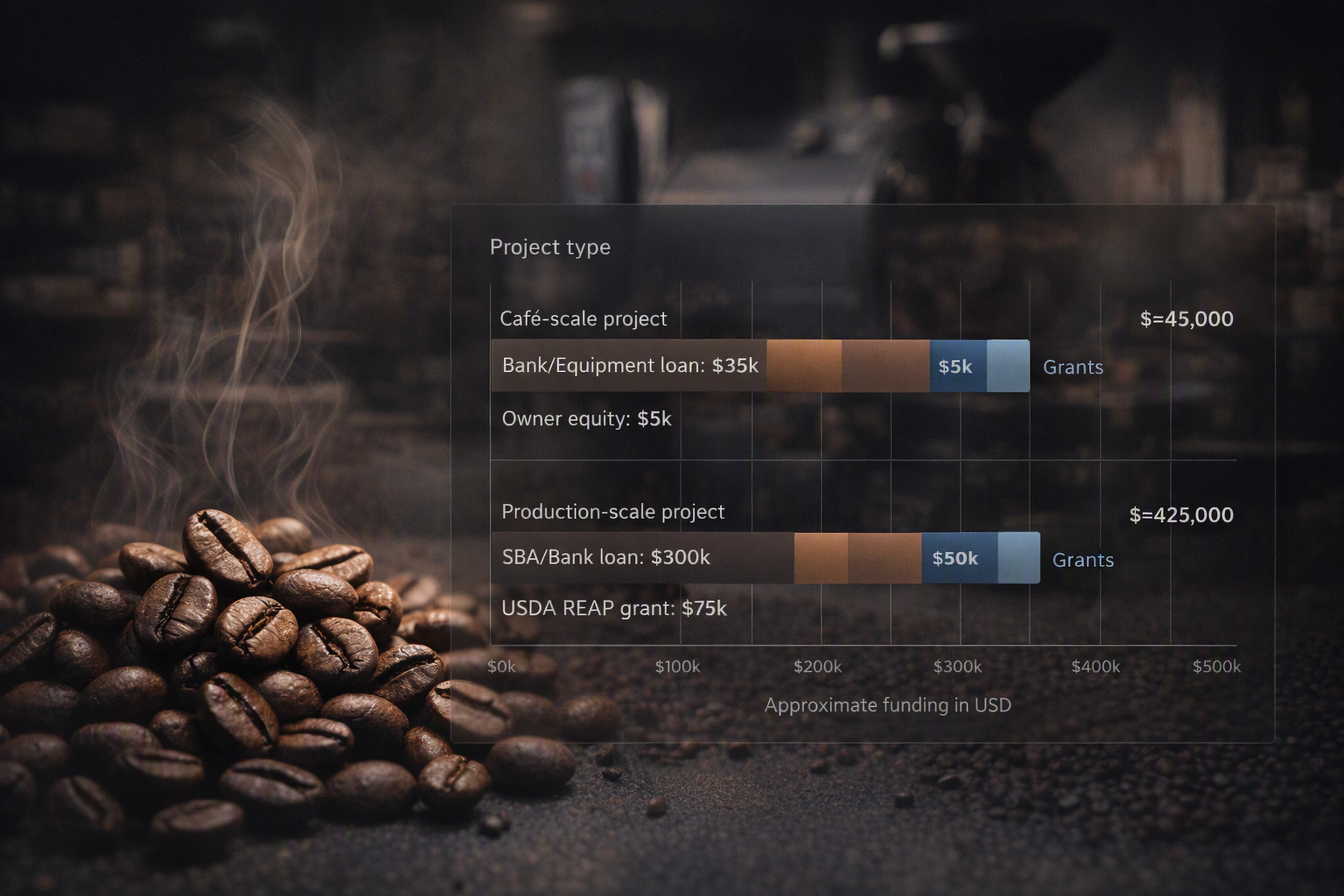
These numbers are planning tools, not quotes. They help investors visualize how electric roasting affects total installed cost and capital mix.
Best electric coffee roasters for specialty cafés (compact commercial recommendations)
If you’re looking for the best electric coffee roaster for a specialty café, focus on:
Throughput vs footprint
Energy use and operating cost
Ability to roast in front of guests
Compact commercial coffee roaster for small café use cases
Vendor‑provided examples:
Typhoon 2.5 PRO (electric fluid‑bed)
Suitable for cafés roasting 15 kg/h or less in‑house.[^typhoon-install]
Transparent roasting chamber for in‑store visibility.
380–400V 3‑phase, 0.3 kWh/kg energy claim.[^typhoon-install]
Typhoon 5 PRO
30 kg/h capacity and up to 6 batches/hour.[^typhoon-install]
Ideal for small roasteries or multi‑site café brands with centralized roasting.
Other electric options in the market (non‑Typhoon):
Bellwether Shop Roaster
MSRP $22,000 standalone or $27,000 with continuous roasting kit (pricing as of public Bellwether blog post).[^bellwether-cost]
Plugs into standard 220V outlet, no gas lines or construction required (vendor claim).[^bellwether-cost]
These systems illustrate how fully electric commercial coffee roaster reviews often highlight ease of installation and sustainability alongside roast quality.
Typhoon Roasters — reviews, sustainability, and specs
Many roasteries evaluating top electric coffee roaster brands for sustainable coffee businesses encounter Typhoon alongside heritage manufacturers.
Typhoon Roasters sustainability & energy performance
Vendor‑provided sustainability claims include:[^typhoon-install][^typhoon-20]
Fully electric platform: no gas lines or open flames.
Approx. 0.3 kWh/kg energy use across compact and industrial models.
Reduced roast defects due to 100% convection fluid‑bed technology.
Typhoon frames this as using roughly 3× less energy per kg than many traditional gas drum roasters; this is a manufacturer comparison based on internal benchmarking and should be treated as indicative rather than a universal standard.
Typhoon Roasters coffee startup equipment: model overview
Selected specs (vendor data):
Typhoon 2.5 PRO
15 kg/h, 5–7 min roast time, 380–400V, ≈0.3 kWh/kg.[^typhoon-install]
Typhoon 5 PRO
30 kg/h, up to 6 batches/hour, 380–400V, ≈0.3 kWh/kg.[^typhoon-install]
Typhoon 10 PRO
60 kg/h, up to 6 batches/hour, footprint 2740 × 1600 × 1980 mm, 380–400V.[^typhoon-install]
Typhoon 20 kg
100 kg/h, 67 kW connection, 380–400V, back‑to‑back batches with no dedicated cool‑down (vendor claim).[^typhoon-20]
Typhoon 30 kg
180 kg/h, 380V, industrial‑scale continuous production.[^typhoon-30]
Typhoon Roasters coffee roaster reviews: where to look
Public third‑party reviews and case studies can be found via:
Specialty coffee forums (e.g., r/coffee_roasters discussions comparing Typhoon to Giesen, Probat, Diedrich).[^reddit-typhoon]
Customer testimonials and install case studies on Typhoon’s own site.[^typhoon-pitch]
Trade show coverage (e.g., World of Coffee showcases) where Typhoon’s fluid‑bed system has been demonstrated.
Pros (based on recurring themes in vendor messaging and user commentary):
High throughput relative to footprint
Repeatable roast curves via software profiles
Lower infrastructure complexity vs gas
Potential cons:
Need for adequate 3‑phase electric service and careful planning of demand charges (a point also raised by Diedrich in their analysis of electric roasting costs).[^diedrich-electric]
Learning curve for roasters transitioning from traditional drum flavor dynamics.
How Typhoon’s electric platform changes lender & investor conversations
Whether you’re pitching a bank or a private investor, electric fluid‑bed roasting lets you frame the project around throughput, efficiency, and sustainability, not just hardware.
Key talking points for your deck
Clear capacity story
Show hourly output (e.g., 30 kg/h for Typhoon 5 PRO, 100 kg/h for Typhoon 20 kg).[^typhoon-install][^typhoon-20]
Model revenue per kg roasted and per hour.
Lower and more predictable operating costs
Use vendor energy data (0.3 kWh/kg) as a baseline.[^typhoon-install]
Compare electric utility rates vs gas costs locally.
Reduced installation risk
Reference electric vs gas installation savings (Bellwether’s $15k–$40k estimated range).[^bellwether-cost]
Emphasize no gas line dependencies and potentially simpler permitting.
Sustainability and brand value
Highlight the move away from fossil fuels and open flames.
Show how visible, in‑café roasting can support premium pricing and storytelling.
Typhoon’s own investor guidance stresses the importance of a clear plan with controllability, scalability, and measurable checkpoints (first 90 days, 12 months, and return scenarios).[^typhoon-pitch]
Actionable steps: preparing to finance your roaster
Use this checklist before approaching lenders or lease providers.
Define your production targets
Daily and weekly kg.
Desired growth over 3–5 years.
Pick a capacity tier and short‑list models
Café focus: Typhoon 2.5 PRO or Typhoon 5 PRO.
Production focus: Typhoon 10 PRO, Typhoon 20 kg, or Typhoon 30 kg.[^typhoon-install][^typhoon-20][^typhoon-30]
Estimate total installed cost
Equipment MSRP or quote.
Electrical, exhaust, construction, permits.
Build a simple ROI and payback model
Project roast volumes, margin per kg, and batch throughput.
Include tax benefits (e.g., Section 179 in the U.S.).[^irs-946]
Prepare lender‑ready documentation
Business plan and financial projections.
Equipment spec sheets (Typhoon, Bellwether, etc.).
Quotes from installers and contractors.
FAQ: financing electric commercial coffee roasters
Which financing option is best for a small specialty café?
For a single café installing a compact electric roaster, an equipment loan or lease is often the most straightforward.
Equipment loans provide ownership and predictable payments, while leases lower upfront costs and offer flexibility to upgrade.
How do I prepare financials for a lender?
Most banks and SBA lenders will expect:
2–3 years of financial projections
A clear explanation of roast volumes and revenue per kg
A breakdown of total project cost (equipment + installation)
Personal financial statements and collateral details (for small owners)
Including vendor specs (e.g., Typhoon’s capacity and energy data) helps connect the machine’s performance to your revenue model.[^typhoon-install]
Can electric coffee roasters qualify for energy‑efficiency grants?
Yes, in some regions.
In the U.S., rural roasteries may apply under USDA REAP for energy‑efficiency grants if they can demonstrate reduced energy use per unit of output.[^usda-reap]
In other countries, local green‑business or efficiency programs may support similar investments.
Are fully electric commercial coffee roaster reviews positive compared to gas?
Industry commentary increasingly treats electric roasting as a credible alternative.
Manufacturers like PROBAT highlight electric hot‑air systems as flexible and fast‑responding.[^probat-p25e]
User reviews on forums show both enthusiasm and learning‑curve notes, especially for roasters transitioning from traditional drum flavor profiles.[^reddit-typhoon]
How does Typhoon compare to other commercial fluid‑bed coffee roasters for small roasteries?
Typhoon’s key differentiation is high throughput plus low energy use across a scalable platform (2.5 kg to 30 kg), all fully electric.[^typhoon-install][^typhoon-20][^typhoon-30]
Other brands like Bellwether focus on ultra‑compact shop roasting and integrated cloud profiles.[^bellwether-cost]
The best choice depends on your capacity targets, installation constraints, and desired level of automation.
If you’d like help modeling ROI or choosing the right Typhoon roaster for your café or roastery, Typhoon’s team offers guidance on both equipment selection and business planning.
[^typhoon-install]: Typhoon Coffee, "Electric Coffee Roaster Installation Requirements," including Typhoon 2.5 PRO, 5 PRO, 10 PRO specifications (380–400V, 3‑phase, 0.3 kWh/kg, 5–7 minute roast times, batch throughput). Available at: https://typhoon.coffee/de/blog/electric-coffee-roaster-installation-requirements
[^typhoon-20]: Typhoon Coffee, "Typhoon 20 kg" equipment page, listing 100 kg/h capacity, 67 kW connection, 380–400V, and back‑to‑back batch capability. Available at: https://typhoon.coffee/de/equipment/typhoon-20kg/
[^typhoon-30]: Typhoon Coffee, "Typhoon 30 kg" equipment page, listing 180 kg/h hourly capacity and 380V requirements. Available at: https://typhoon.coffee/equipment/typhoon-30kg/
[^bellwether-cost]: Bellwether Coffee, "Commercial Coffee Roaster Cost" blog post, citing $22,000 MSRP for the Shop Roaster, $27,000 with Continuous Roasting Kit, and estimated $15,000–$40,000 installation savings vs gas systems. Available at: https://bellwethercoffee.com/blog/commercial-coffee-roaster-cost
[^sba-7a]: U.S. Small Business Administration, "7(a) Loans" overview, listing $5 million 7(a) cap, $5.5 million 504 cap, and 2026 rule permitting combined 7(a)+504 financing up to $10 million. Available at: https://www.sba.gov/loans/7a-loans/
[^bofa-equipment]: Bank of America, "Business Equipment Loans" and SBA information, noting loans from $25,000 with terms up to 5 years and SBA 504 down payments as low as 10%. Available at: https://www.bankofamerica.com/smallbusiness/business-financing/business-equipment-loans/
[^usda-reap]: USDA Rural Development, "REAP Renewable Energy Systems & Energy Efficiency Improvement" fact sheet, listing grant ranges ($1,500–$250,000 for efficiency; $2,500–$500,000 for renewables) and combined support up to 75% of eligible project costs. Available at: https://www.rd.usda.gov/sites/default/files/508_RD_FS_RBS_REAP_RE_EE.pdf
[^irs-946]: Internal Revenue Service, Publication 946 (2025 version covering tax years beginning in 2026), describing Section 179 maximum deduction of $2.56 million and 100% additional first‑year depreciation for eligible property acquired after January 19, 2025. Available at: https://www.irs.gov/pub/irs-prior/p946--2025.pdf
[^probat-p25e]: PROBAT, "Sustainability meets flexibility: the new P25e" news release, describing electric hot‑air roasting with fast response and minimal heat‑up/cool‑down penalties. Available at: https://www.probat.com/newsroom/news/sustainability-meets-flexibility-the-new-p25e/
[^diedrich-electric]: Diedrich Roasters, "The True Cost of Electricity" article, discussing real‑world issues around power availability, demand charges, and installation requirements for electric roasting. Available at: https://www.diedrichroasters.com/true-cost-of-electricity-2025/
[^reddit-typhoon]: Reddit, r/coffee_roasters discussions comparing Typhoon Roasters with drum roaster brands, such as thread "Typhoon vs Giesen" and similar. Example: https://www.reddit.com/r/coffee_roasters/comments/108wb6t
[^typhoon-pitch]: Typhoon Coffee, "Pitching a New Roaster to Investors," describing investor expectations around controllability, scalability, and clear milestones. Available at: https://typhoon.coffee/pitching-a-new-roaster-to-investors/