







Caffè in Generale

Scritto da:

Editoriale Typhoon
Amanti della tostatura
Launching a roastery is one of the most exciting moves a café or coffee startup can make.
Launching a roastery is one of the most exciting moves a café or coffee startup can make.
It's also where many founders make their first big equipment mistake: buying a roaster that doesn't match their true demand, utilities, or growth path.
This guide gives you a practical, step‑by‑step framework for choosing your first commercial coffee roaster, with clear comparisons of batch size, power source, footprint, workflow, and scalability—and where Typhoon's electric fluid‑bed lineup fits into that picture.
1. Start With Your Sales Model, Not the Machine
Before you look at batch sizes or brand names, define how you'll sell roasted coffee in the first 12–18 months.
1.1 Clarify your main revenue streams
Most startup roasteries fall into one or more of these buckets:
Café only: roasting to supply your own espresso bar(s).
Café + retail bags: in‑house service plus 250 g / 1 lb bags.
Wholesale‑first: selling to other cafés, offices, grocery.
Online‑first: subscriptions and web orders.
Each model creates a different daily volume and workload pattern.
1.2 Why this matters for your first roaster
Café‑only operations can often thrive on 5–20 kg/day.
Medium to larger cafés and early wholesale can push into 15–50 lb/day (≈7–23 kg) according to Coffee Crafters.
Your first machine should comfortably cover today's demand + 12–18 months of realistic growth, not your 5‑year dream scenario.
Choosing a roaster for your current model plus the next step dramatically improves ROI and reduces risk.
2. Estimate Your Daily Roasted Volume (in kg/day)
Once your sales model is clear, translate it into daily roasted volume.
2.1 Simple way to estimate café consumption
For a single café:
Count drinks per day (or estimate based on similar shops).
Assume 18–20 g of coffee per espresso drink.
Include filter and batch brew usage.
Quick rule of thumb:
Small café: 5–10 lb/day (≈2–5 kg).
Medium/large specialty café: 15–50 lb/day (≈7–23 kg).
Many single‑location cafés fall into 15–20 kg/day, according to Bellwether.
2.2 Add retail, online, and wholesale
Estimate weekly:
Retail bags sold.
Subscription volume.
Wholesale orders.
Then convert to a daily roasting average (e.g. "we roast 2 days/week").
If you expect 30 kg/week and roast twice weekly, that's 15 kg per roast day.
Add a 25–30% buffer to allow for growth and cupping/testing.
3. Audit Your Utilities and Space Before You Shop
Many startups discover late that their dream machine needs power or gas they don't have.
Do this check before you compare roasters.
3.1 Power requirements
Key questions:
Do you have 240V single‑phase or 380–400V three‑phase power?
How many amps can you realistically allocate?
Examples:
Bellwether 1.5 kg roaster: ~5 kW, 200–240 VAC / 30A, countertop‑friendly.
Typhoon 2.5 PRO: 16 kW, 380–400V, up to 15 kg/h throughput.
Typhoon 5 PRO: 23 kW, 380–400V, up to 30 kg/h.
Typhoon 10 PRO: 46 kW, 380–400V, up to 60 kg/h.
Giesen W15E (electric 15 kg): 400V / 3×63A, up to 32 kW.
Bellwether®, PROBAT®, Diedrich®, Giesen®, and Loring® are trademarks of their respective owners. Typhoon is not affiliated with or endorsed by these companies.
For many locations, especially in North America, the real decision is: can your site support 400V three‑phase or not?
3.2 Gas and ventilation
If you're considering gas drum roasters (e.g. Giesen W15A, Diedrich gas models, Loring), check:
Is gas available, and can you install a new line?
What is the local permitting process for combustion equipment?
Can you install proper exhaust and make‑up air?
Fully electric roasters like Typhoon or Bellwether reduce that complexity, but you still need to consider general ventilation and chaff/smoke management according to local codes.
3.3 Footprint and floor load
Measure:
Available floor space.
Access (door widths, stairs, elevators).
Ceiling height.
Typical examples:
Typhoon 2.5 PRO: 1800 × 1150 × 1650 mm, 310 kg.
Typhoon 5 PRO: 2150 × 1300 × 1900 mm, 480 kg.
Typhoon 10 PRO: 2740 × 1600 × 1980 mm, 920 kg.
For café‑roasteries, compact, visually open machines like the Typhoon Shop PRO series also double as experiential theatre inside the café.
4. Choose the Right Batch Size and Throughput
Batch size is the most visible spec, but throughput per hour is often more important for a startup.
4.1 Understanding batch vs throughput
Batch size = how much green coffee you roast per cycle.
Throughput = how many kg you can roast per hour, including back‑to‑back batches.
Because cooling, loading, and warm‑up differ across machines, two "5 kg roasters" can have radically different hourly outputs.
4.2 Typhoon throughput examples
Typhoon's electric fluid‑bed roasters use 5–7 minute roast times and no dedicated cool‑down cycle, enabling up to 6 batches/hour.
Typhoon 2.5 PRO — Batch: 2.5 kg. Throughput: 15 kg/h. Roast time: 5–7 min. Energy: ~0.3 kWh/kg.
Typhoon 5 PRO — Batch: 5 kg. Throughput: 30 kg/h. Roast time: 5–7 min. Energy: ~0.3 kWh/kg.
Typhoon 10 PRO — Batch: 10 kg. Throughput: 60 kg/h. Roast time: 5–7 min.
For growing roasteries:
Typhoon 20 KG: ~100 kg/h.
Typhoon 30 KG: ~180 kg/h, up to 6 batches/hour.
A classic drum roaster of similar batch size may be limited to 3–4 batches/hour due to longer roast and cool‑down, effectively halving hourly output.
4.3 Matching throughput to your daily demand
A good rule: your roaster should cover your entire daily volume in 2–4 hours of roasting, not a full 8‑hour shift.
Examples:
Daily need 15 kg: Typhoon 2.5 PRO (15 kg/h) can cover this in ≈1 hour.
Daily need 30 kg: Typhoon 5 PRO (30 kg/h) covers this in ≈1 hour.
Daily need 60 kg: Typhoon 10 PRO (60 kg/h) covers this in ≈1 hour.
This gives you headroom for growth, experimentation, and maintenance.
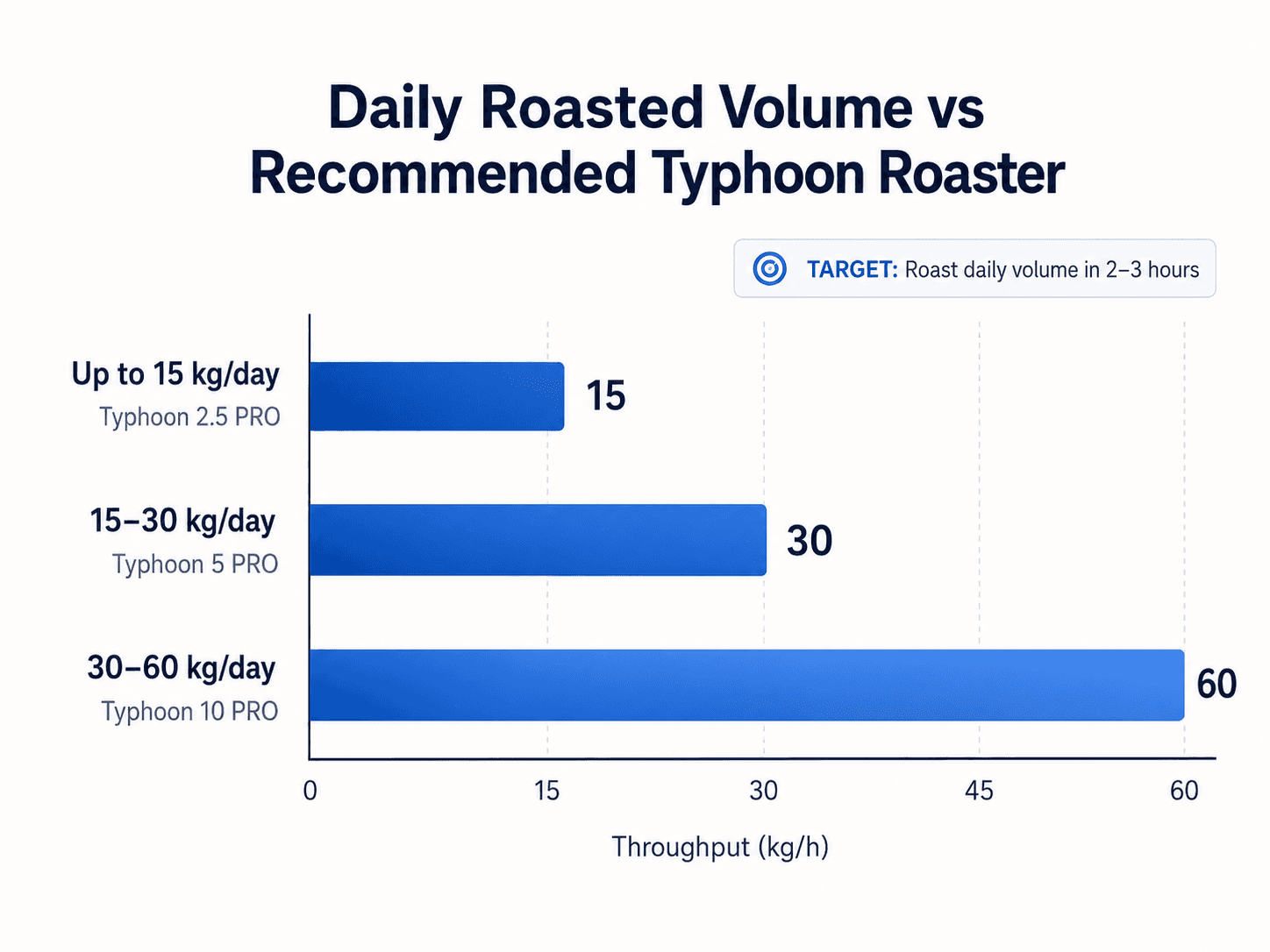
Here's how typical daily volumes map to machine classes:
5. Compare Electric vs Gas for a Startup Roastery
Electric commercial coffee roasters have moved from niche to mainstream. Major manufacturers—including Diedrich, PROBAT, Bellwether, and Typhoon—now offer fully electric models.
5.1 Pros of electric roasters
Simpler permitting: no combustion, no gas line.
Easier installation: often plug‑and‑play once power is in place.
Energy use: Typhoon roasters run at roughly 0.3 kWh/kg across the Typhoon PRO/KG lineup.
Sustainability narrative: easier to pair with renewable electricity; aligns with ESG goals.
Consistent heat delivery: electric elements and fluid‑bed convection provide stable, controllable energy.
5.2 Pros of gas drum roasters
Familiarity: the traditional standard; many roasters learned on gas drums.
Hands‑on control: tactile, analog style fits some brand stories.
High batch sizes: many 15–30 kg machines available from trusted manufacturers.
5.3 Where Typhoon fits
Typhoon's position is clear: fully electric, 100% convection, 0% gas.
For a startup deciding between an electric coffee roaster vs gas drum, Typhoon offers:
Industrial‑grade outputs (up to 180 kg/h) with no gas infrastructure.
Defect‑free, specialty‑grade roasting thanks to fluid‑bed technology that heats the entire bean mass evenly.
Roughly 0.3 kWh/kg across the Typhoon PRO/KG lineup.
A single technology platform from 2.5 kg to 30 kg, so scaling up doesn't mean relearning roasting.
If your cafe or roastery wants a top electric coffee roaster for sustainable business, Typhoon's 10 PRO reaches 60 kg/h — well above PROBAT's largest all-electric model, the P12 E, at ~40 kg/h.
6. Don't Ignore Workflow, Automation, and Training
Two roasters with the same capacity can create totally different workloads for your team.
6.1 Key workflow questions
Ask each manufacturer:
How long is a typical roast from charge to drop?
Is there a separate cool‑down cycle that blocks roasting?
How many batches per hour are realistic in production?
Is there recipe storage and automation for consistent profiles?
What data logging is available (temperature curves, events, integration with Cropster/Artisan)?
6.2 Typhoon's workflow advantages
Typhoon's fluid‑bed roaster is designed for speed and repeatability:
No dedicated cool‑down; roast and cool simultaneously for back‑to‑back batches.
Up to 6 batches/hour, even on shop roasters.
Recipe storage and automation: once you dial in a profile, you can repeat it consistently across operators.
Transparent roasting chamber turns the process into in‑store theatre, ideal for cafés wanting customers to see and feel the roasting story.
For a startup with rotating staff, this means shorter training times and less dependence on a single master roaster.
7. Plan Your Growth Path: Buy for 12–18 Months, Not 10 Years
Your first roaster should be the right tool for the next 12–18 months of realistic growth.
7.1 Why "oversizing" can hurt
Buying a massive machine too early can:
Increase idle energy and operating costs.
Require heavier electrical upgrades or gas infrastructure.
Make it harder to experiment with very small test batches.
Instead, think in platform steps.
7.2 Typhoon as a growth ladder
Typhoon's lineup is intentionally structured as a ladder from café to industrial scale:
Typhoon 2.5 PRO – Best first roaster for: Single cafés or micro‑roasteries up to ~15 kg/day. Concept shops wanting a compact commercial coffee roaster inside the café.
Typhoon 5 PRO – Best first roaster for: Café + retail bag operations at 15–30+ kg/day. Startup roasteries with early wholesale accounts.
Typhoon 10 PRO – Best first roaster for: Regional micro‑roasteries targeting 30–60+ kg/day. Operators planning to add a second or third location soon.
Typhoon 20 KG & 30 KG – Next steps for: Established roasteries handling 100–180 kg/h. Brands moving into supermarket or large‑scale wholesale.
Because the roast interface and convection technology are consistent across the range, upgrading later is more like increasing capacity on a familiar platform than starting over.
8. A Practical Step‑by‑Step Framework
Here's the full decision process you can follow when choosing your first commercial coffee roaster for a startup roastery.
Define your sales model.
Café‑only, café + retail, wholesale, or online.
Estimate first‑year demand.
Use 15–20 kg/day as a sanity check for single cafés.
Add retail and wholesale, then apply a 25–30% buffer.
Audit utilities and space.
Check for 240V vs 380–400V three‑phase.
Confirm available amps, ventilation, and floor space.
Set a target throughput.
Aim to roast your daily volume in 2–4 hours.
Use the roaster's kg/h throughput, not just batch size.
Decide electric vs gas.
Electric for simplicity, sustainability, and ease of installation.
Gas if you have infrastructure and want classic drum roasting.
Compare workflow and automation.
Look at roast time, cooldown, batch turnover, and recipe storage.
Evaluate operator training needs.
Choose the smallest roaster that meets your needs with headroom.
For many startups: Up to ~15 kg/day → Typhoon 2.5 PRO. 15–30+ kg/day → Typhoon 5 PRO. 30–60+ kg/day → Typhoon 10 PRO.
Plan your growth ladder.
Expect to upgrade in 3–5 years as you scale.
Prefer a platform (like Typhoon) where stepping up doesn't require changing technology.
9. FAQ: Choosing Your First Commercial Coffee Roaster
What size coffee roaster do I need for a roastery startup?
Most single‑location specialty cafés can start with a 2.5–5 kg roaster, provided the machine offers high throughput.
If you're roasting 15–20 kg/day, a Typhoon 2.5 PRO (15 kg/h) or 5 PRO (30 kg/h) will cover your needs in 1–2 hours, leaving room for growth.
Is an electric coffee roaster better than a gas drum for a startup?
It depends on your context.
Electric roasters simplify installation (no gas line), support better sustainability stories, and can be highly energy‑efficient—Typhoon's fluid‑bed roasters use roughly 0.3 kWh/kg across the Typhoon PRO/KG lineup.
Gas drum roasters remain a solid choice for those with gas infrastructure and a preference for classic, manual roasting.
What is the best first roaster for a micro‑roastery in a small café?
If you want a compact commercial coffee roaster with strong throughput and an in‑café presence, a Typhoon 2.5 PRO is a strong candidate.
It offers 2.5 kg batches, 15 kg/h throughput, fast 5–7 minute roasts, and an open, transparent design that lets customers see the roasting process.
How important is throughput per hour vs batch size?
Throughput per hour is usually more important.
A 5 kg roaster that can run 6 batches/hour (30 kg/h) is more productive than a 10 kg machine limited to 2 batches/hour (20 kg/h).
Look closely at roast time, cooling, and turnover, not just the nominal batch.
How does Typhoon compare to other electric commercial roaster manufacturers?
Typhoon focuses on fully electric, 100% convection fluid‑bed roasting with a strong emphasis on speed, energy efficiency, and consistency.
Typhoon's industrial-class models (20–30 KG) reach up to 180 kg/h — a step up from Typhoon's own café‑scale lineup, giving roasteries a single technology platform to grow into as they scale from shop to industrial volume.
Industrial-class throughput options (up to 180 kg/h).
Energy use around 0.3 kWh/kg across the Typhoon PRO/KG lineup.
A unified platform from small shop roasters to industrial‑scale roasters.
If you'd like to model your exact demand and see which Typhoon roaster matches your café or roastery plans, the next step is to map your current daily kg, projected 12–18 month growth, and available power. From there, it's a straightforward decision between the 2.5, 5, and 10 kg classes for most startups—and a clear path to 20 or 30 kg as your brand scales.