




Café en General

Escrito por:

Editorial Typhoon
Amantes del tostado
Launching a roastery or adding in‑house roasting to your café is a major investment.
Electric vs Gas Drum Coffee Roasters: What Startups Really Pay For
Launching a roastery or adding in‑house roasting to your café is a major investment.
The equipment decision often comes down to one core question:
Electric fluid‑bed coffee roaster vs gas drum roaster — which actually costs less and pays back faster?
When you look beyond sticker price, electric roasters like Typhoon Roasters often deliver shorter ROI timelines, lower risk, and more scalable operations.
This guide breaks down the full financial picture so you can model your own numbers with confidence.
Snapshot: Electric Fluid‑Bed vs Gas Drum Roasters
Before diving into details, here's the high‑level comparison for a typical café or micro‑roastery.
Electric fluid‑bed roaster (Typhoon as reference):
Fully electric, no gas line required
100% convection / fluid‑bed roasting
Fast roast times (about 5–7 minutes) and up to 6 batches/hour
Energy use around 0.3 kWh per kg of coffee
Simple installation (often standard electrical + minimal ventilation)
Lower ongoing maintenance and no afterburner
Gas drum roaster:
Gas burner + metal drum
Typically 10–15 minute roasts with 3–4 batches/hour common
Requires gas line, combustion ventilation, and often an afterburner
Higher fuel consumption, especially with afterburner
More complex installation and permitting
The result is a different cost structure across capex, opex, and scalability.
1. Upfront Equipment Costs
Sticker price vs project price
One trap many startups fall into: comparing the roaster price alone, not total project cost.
Gas drum roasters often look competitive on sticker price.
Electric fluid‑bed roasters may be similar or slightly higher.
But once you add ventilation, gas lines, and afterburners, the gas setup usually costs far more overall.
Typhoon Roasters as a reference
Public pricing for Typhoon is quote‑based today, but past data points give a reasonable range:
A 2.5 kg electric model was reported around €13,000 in 2021.
30 kg industrial models were around €60,000 electric / €63,000 gas‑heated.
For comparison, other fluid‑bed brands like Coffee Crafters list a Valenta 12 — roughly comparable in throughput to Typhoon's 5 PRO — at $12,500–$15,995 for about 72 lb/h (~33 kg/h).
Bellwether®, Coffee Crafters®, PROBAT®, and Giesen® are trademarks of their respective owners. Typhoon is not affiliated with or endorsed by these companies.
The key takeaway: roaster equipment costs are in the same ballpark across technologies.
The real difference shows up in what it takes to install and operate them.
2. Installation Costs: The Hidden Gas Premium
What gas drum roasters typically require
For indoor roasting (especially in cafés and urban spaces), gas drum roasters usually need:
Hood: approx. $3,000–$8,000
Ductwork: approx. $2,000–$5,000
Afterburner (or similar emissions control): often $10,000–$30,000
Make‑up air: approx. $2,000–$5,000
Gas line installation: approx. $5,000–$15,000
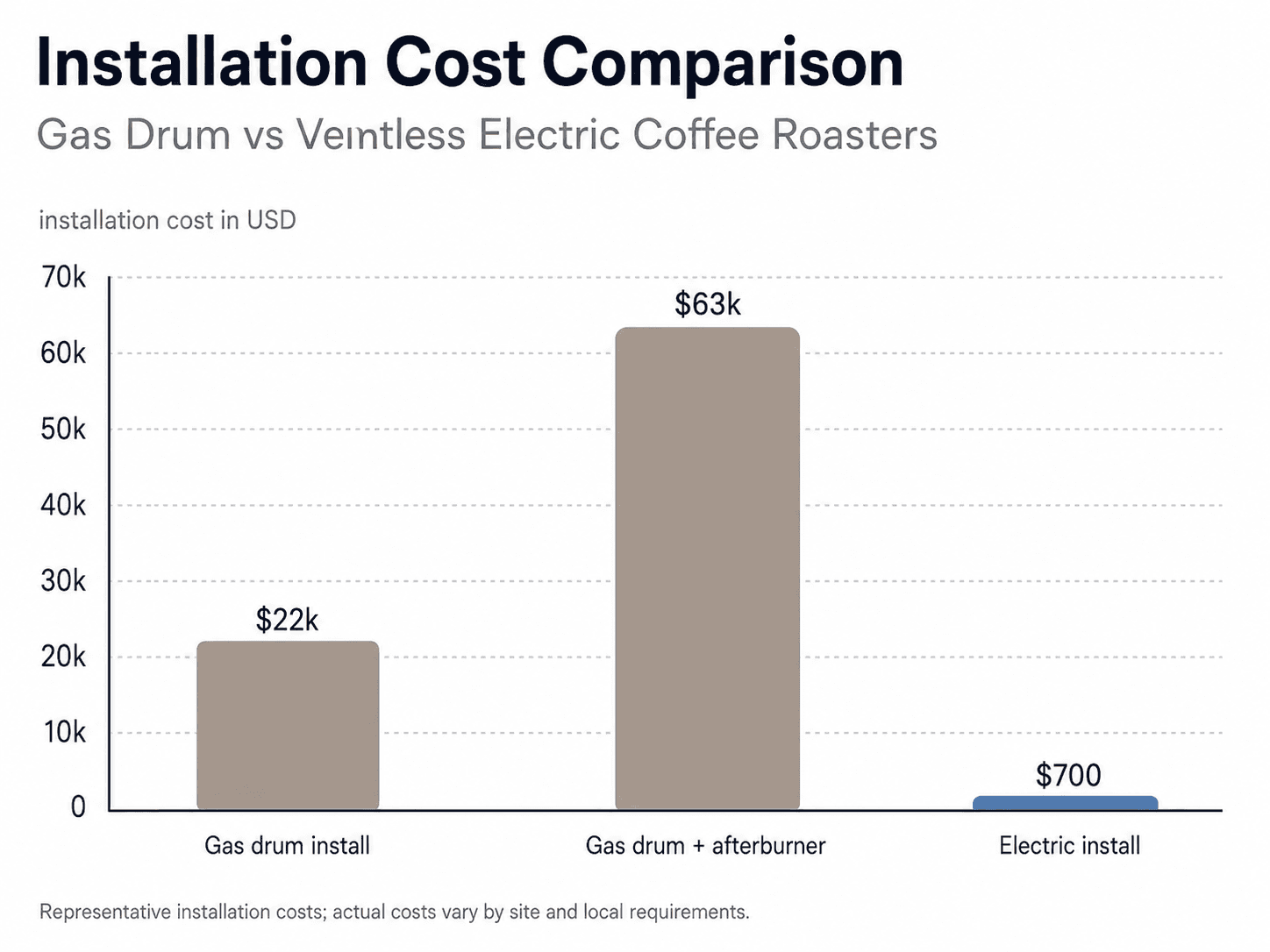
Bellwether's 2026 café guide puts total gas infrastructure in the range of $22,000–$63,000 before you even buy the roaster.
Other estimates show complete gas installs at $26,500–$84,000, depending on building and local codes.
Electric fluid‑bed installation
Fully electric, vented or ventless roasters avoid most of that complexity.
No gas line
No open flame
No dedicated afterburner in many cases
Often standard electrical service + simple venting
Bellwether estimates ventless electric installation at $700–$2,500 in many café scenarios.
Typhoon's shop‑scale roasters (e.g., Typhoon 2.5 PRO and 5 PRO) are designed for:
Standard 380–400V three‑phase service
Transparent roasting chambers suitable for in‑café placement
Compact footprints that integrate into retail environments
Bottom line: It's common for electric roasters to be $15,000–$40,000 cheaper to install than gas drum roasters of similar capacity once all infrastructure is included.
3. Energy Consumption and Fuel Cost per kg
Current utility prices (U.S. benchmarks)
Using April 2026 EIA data as a reference:
Commercial electricity: 13.51¢/kWh
Commercial natural gas: $12.36 per thousand cubic feet, around $11.93/MMBtu
Your local prices will vary, but the ratios are helpful for modeling.
Electric fluid‑bed: Typhoon's energy profile
Typhoon publishes clear energy use numbers:
~0.3 kWh per kg of roasted coffee
At 13.51¢/kWh, that's roughly:
$0.04 per kg in electricity cost
For a café roasting 15 kg/day:
Energy cost ≈ $0.60 per day or about $18 per month (assuming 30 days).
For a small roastery at 30 kg/day:
Energy cost ≈ $1.20 per day or about $36 per month.
Gas drum + afterburner: higher fuel load
A typical setup might include:
Roaster burner: ~20,000 BTU/h
Afterburner: ~400,000 BTU/h
At around 20 kg/h output, this translates, near nameplate, to approximately:
$0.25 per kg in gas cost.
That's more than 6x the energy cost per kg compared to a Typhoon running at 0.3 kWh/kg under current U.S. prices.
Over time, that delta adds up:
At 15 kg/day: $3.75/day → about $112/month in gas.
At 30 kg/day: $7.50/day → about $225/month.
Conclusion: Electric fluid‑bed roasting is not just cleaner; it's typically dramatically cheaper to fuel per kg, especially when afterburners are involved.
4. Maintenance and Service Costs
Gas drum roasters
Gas roasters have more moving parts and combustion‑related components:
Burners
Valves and regulators
Exhaust and ducting
Afterburner or catalytic units
Bellwether's comparison suggests:
Typical gas roaster maintenance: $1,000–$3,000/year
Total annual service, including exhaust/afterburner: $2,000–$7,000/year
Plus, unexpected downtime can be costly:
Burner and afterburner failures
Code inspections and certifications
Electric fluid‑bed roasters
Electric roasters generally have:
Heating elements
Fans and blowers
Control electronics
But no gas trains, no open flame, and usually no external afterburner.
Bellwether pegs annual service for electric roasters at roughly:
$200–$500/year in routine maintenance.
Typhoon adds:
2‑year warranties
Extensive pre‑shipment testing (around 20 test roasts per machine)
Dedicated service managers and online support
This reduces both predictable maintenance costs and risk of downtime.
5. Labor, Throughput, and Opportunity Cost
Roast speed and batches per hour
Labor and uptime can matter as much as energy costs.
Typhoon's shop‑scale roasters are built around fluid‑bed convection:
Typhoon 2.5 PRO
Nominal capacity: 15 kg/h
Roast time: 5–7 minutes
Up to 6 batches/hour
Typhoon 5 PRO
Nominal capacity: 30 kg/h
Roast time: 5–7 minutes
Up to 6 batches/hour
All Typhoon models share:
Fast back‑to‑back batches (no dedicated cool‑down cycle)
Automated profiles and recipe storage
In contrast, many gas drum roasters:
Run 10–15 minute roast cycles
Require separate cooling
Max out around 3–4 batches/hour at similar batch sizes
Why this matters for ROI
Faster, automated roasting means:
Fewer staff hours tied to the roaster
More flexible scheduling (roast in short windows)
Higher production capacity without buying a larger machine
For a growing business, the ability to double throughput at the same batch size is a direct driver of revenue.
Typhoon's platform often becomes not just a cost saver, but a growth enabler.
6. Scalability and Future‑Proofing
A single platform from café to industrial scale
Typhoon's range illustrates how an electric fluid‑bed approach scales:
Typhoon 2.5 PRO: ~15 kg/h
Typhoon 5 PRO: ~30 kg/h
Typhoon 10/20/30 kg: 60 / 100 / 180 kg/h respectively
All share:
The same 100% convection technology
Similar control interface and workflow
Recipe storage and automation
For startups, this matters because:
Staff can move between machines with minimal retraining.
Upgrading capacity doesn't mean learning a new roast style.
Data and profiles remain consistent as you scale.
Market trend: electrification is now mainstream
Industry leaders are moving in the same direction:
PROBAT offers electric and even hydrogen options in its P‑series, with electric catalytic exhaust solutions.
Giesen sells electric models like the W1E, W6E, and W15E alongside gas.
Electric roasting is emerging as the new standard for safety, sustainability, and flexibility.
7. ROI Timelines: What Startups Can Expect
Typhoon's published payback claims
Typhoon publicly states fast payback periods at partial utilization:
Typhoon 2.5 PRO: about 4 months ROI at 30% load
Typhoon 5 PRO: about 3 months ROI at 30% load
"Load" here means using only 30% of the machine's maximum hourly capacity, not running flat‑out.
Why ROI is so short
Several factors combine:
Low installation cost compared to gas
Low energy cost per kg (~$0.04/kg vs ~$0.25/kg for gas + afterburner)
Higher throughput (6 batches/hour vs 3–4)
Automation and repeatability, reducing training and labor waste
For cafés, bringing roasting in‑house can unlock margins of $8–$15 per kg or more compared to buying roasted coffee wholesale.
When installation and operating costs are modest, those margins translate into fast payback.
How to think about your own ROI
To estimate your timeline, plug these into a simple model:
Projected roasted volume (kg/month)
Margin per kg (retail or wholesale price minus green + overhead)
Total project cost (roaster + install + initial inventory)
Monthly operating costs (energy, maintenance, labor)
Then calculate:
Monthly net profit from roasting = (volume × margin/kg) – operating costs
ROI months = total project cost ÷ monthly net profit
Because electric fluid‑bed roasters dramatically reduce install and operating costs, you'll often see single‑digit month payback periods even at modest volumes.
8. Is Electric Fluid‑Bed Right for Your Startup?
Electric isn't automatically the right choice for every scenario, but it's increasingly compelling when:
You're building a café roastery or micro‑roastery in an urban space.
Gas infrastructure is complicated, costly, or slow to permit.
You care deeply about consistent, defect‑free specialty roasting.
You want roasting to be part of your brand story (visible, clean, in‑store theatre).
You're modeling ROI and cash flow carefully and need predictable costs.
Typhoon Roasters in particular suits:
Specialty cafés adding 2.5–5 kg roasters inside the shop
Startups planning 15–120+ kg/h regional roasting with a scalable platform
If you're comparing electric vs gas drum coffee roaster cost for your startup, it's worth modeling both the upfront and lifetime costs — and considering how fast you want your investment to pay back.
Actionable Next Steps for Cafés and Micro‑Roasteries
If you're evaluating an electric fluid‑bed vs gas drum roaster:
Audit your space and local regulations
Are gas lines allowed or practical?
What are the hood and duct requirements?
Request full project quotes, not just roaster prices
Include ventilation, gas lines, afterburner, make‑up air, electrical work.
Calculate energy cost per kg
Ask each vendor for kWh/kg or BTU/h and use current utility rates.
Model throughput and labor
Compare batches/hour and automation features.
Run an ROI scenario at 30–50% load
This is closer to real operations than assuming full capacity.
Typhoon's team can help you walk through these numbers with your actual café or roastery plans, so you're not guessing.
FAQ: Electric vs Gas Drum Coffee Roasters
1. Are electric coffee roasters really cheaper to run than gas?
In most café and micro‑roastery scenarios, yes.
Typhoon's electric fluid‑bed roasters run at around 0.3 kWh/kg, which is about $0.04/kg at current U.S. commercial electricity prices.
A gas drum roaster with an afterburner can be closer to $0.25/kg, making gas more than 6x more expensive per kg on fuel alone.
2. How much does installation cost for a commercial gas roaster?
For indoor roasting, gas drum roasters typically require:
Hood, ductwork, afterburner, make‑up air, and gas line
Multiple industry sources put this at roughly $22,000–$63,000 — and in some cases $26,500–$84,000 — before the roaster itself.
Electric roasters often install for $700–$2,500 in similar spaces.
3. What is the typical payback period for a Typhoon roaster in a café?
Typhoon publishes payback estimates of:
~4 months for the 2.5 PRO at 30% load
~3 months for the 5 PRO at 30% load
Actual ROI will depend on your volume and margins, but these numbers show that, with electric fluid‑bed technology and low install costs, payback can be measured in months, not years.
4. Do electric roasters have enough capacity for a growing roastery?
Yes.
Typhoon's electric platform scales from:
15 kg/h (2.5 PRO) to
30 kg/h (5 PRO) and
60 / 100 / 180 kg/h (10/20/30 kg industrial models)
All use the same fluid‑bed convection approach and control logic, so capacity upgrades don't require a complete process change.
5. Are gas drum roasters going away?
No, but the market is clearly shifting.
Legacy brands like PROBAT and Giesen now offer electric models and hybrid exhaust solutions alongside gas.
For many new startups — especially urban cafés and sustainability‑minded roasteries — electric roasting is becoming the default choice, with gas reserved for specific contexts where infrastructure already exists.
For cafés and roasteries planning their next move, the question isn't just "drum or fluid‑bed?" — it's how quickly you want your roasting investment to pay you back, and how flexible you need it to be as you grow.
Typhoon's electric fluid‑bed roasters offer a clear, data‑driven path to fast ROI, consistent quality, and a future‑proof roastery built around efficiency, sustainability, and experience.