




Café en General

Escrito por:

Editorial Typhoon
Amantes del tostado
If you run a specialty café or small roastery, you’ve probably asked yourself:
Why Fluid‑Bed Roasting Matters for Modern Cafés and Roasteries
If you run a specialty café or small roastery, you’ve probably asked yourself:
What is fluid‑bed coffee roasting?
How does 100% hot air change flavor, defects, and consistency compared with my gas drum?
Is an electric fluid‑bed roaster actually a smarter move for my next upgrade?
This guide demystifies fluid‑bed roasting in practical terms, with a focus on what it means for flavor, repeatability, and the business side of your roastery.
We’ll use Typhoon Roasters as a reference point, but the physics applies to fluid‑bed roasting in general.
What Is Fluid‑Bed Coffee Roasting?
In a fluid‑bed roaster, coffee beans are roasted by a controlled stream of high‑velocity hot air.
Instead of sitting in a rotating metal drum heated by gas burners, beans are suspended and “floated” on a cushion of air in a transparent chamber.
Key characteristics:
100% convection: Heat is delivered by moving hot air, not by contact with hot metal.
Suspended beans: Airflow is strong enough to lift and mix the entire bean mass.
Fast heat transfer: Turbulent air flow transfers energy quickly and evenly.
Academic sources describe this as roasting “exclusively based on convective heat transfer,” which is exactly what modern fluid‑bed platforms like Typhoon are designed to do.
How 100% Convection Actually Works
The physics in simple language
In fluid‑bed roasting, hot air does three jobs at once:
Heats the beans via convection.
Moves the beans, creating constant circulation.
Removes chaff and smoke from the roast chamber.
Hot air enters from below, flows through the perforated roast bed, and fluidizes the beans. This “fluidized bed” behaves almost like a boiling liquid—constantly moving, self‑mixing, and very responsive to changes in airflow and temperature.
Why this matters versus a drum roaster
In a classic gas drum roaster, heat transfer is a mix of:
Conduction: bean touching hot drum metal.
Convection: hot air circulating inside the drum.
Radiation: heat from the drum walls and burners.
That mix can work beautifully in skilled hands, but it also creates hot spots and the risk of roast defects when metal surfaces overheat.
In fluid‑bed systems:
No drum contact: Beans are not pressed against a hot metal surface.
Uniform air flow: All beans are exposed to similar conditions.
Direct control: You change the roast curve by adjusting air temperature and speed.
This is the foundation for the “100% convection, 0% compromise” message you’ll see from electric fluid‑bed manufacturers.
Bean Movement: Why the “Fluid” Matters
What does bean movement look like in a fluid‑bed roaster?
From the outside, it looks like a fountain:
Beans rise through the center of the chamber on a column of hot air.
They fall back down the sides, then are pulled into the air stream again.
This cycle repeats several times per second across the entire batch.
The result is highly uniform bean exposure to heat.
On Typhoon’s transparent chambers, you can literally watch:
Even color development across the whole batch.
Chaff removal in real time.
Phase transitions (yellowing, first crack, post‑crack development) with excellent visibility.
Why movement matters for quality
Consistent bean movement helps you:
Reduce hot and cold spots inside the batch.
Avoid localized over‑roasting on the bean surface.
Achieve tighter density and color distribution, which shows up as more consistent extraction on bar.
For cafés and micro‑roasteries, this translates into fewer surprises when you cup production batches or dial in on espresso.
Heat Transfer in Fluid‑Bed Roasting: Faster, Cleaner Energy
Convection‑first heat transfer
In fluid‑bed roasting, heat transfer is dominated by convection:
High‑velocity air creates turbulent flow around each bean.
Turbulent flow increases the rate of heat transfer dramatically.
Beans reach target temperature quickly and evenly.
Academic work on fluidized‑bed roasters confirms this: they are designed specifically for fast roasting because of the intense convective heat exchange.
Real‑world numbers: Typhoon as an example
Vendor‑reported specs for Typhoon’s commercial fluid‑bed roasters:
2.5 PRO (compact commercial coffee roaster for small cafés)
2.5 kg nominal batch
15 kg/h production
5–7 minute roast time
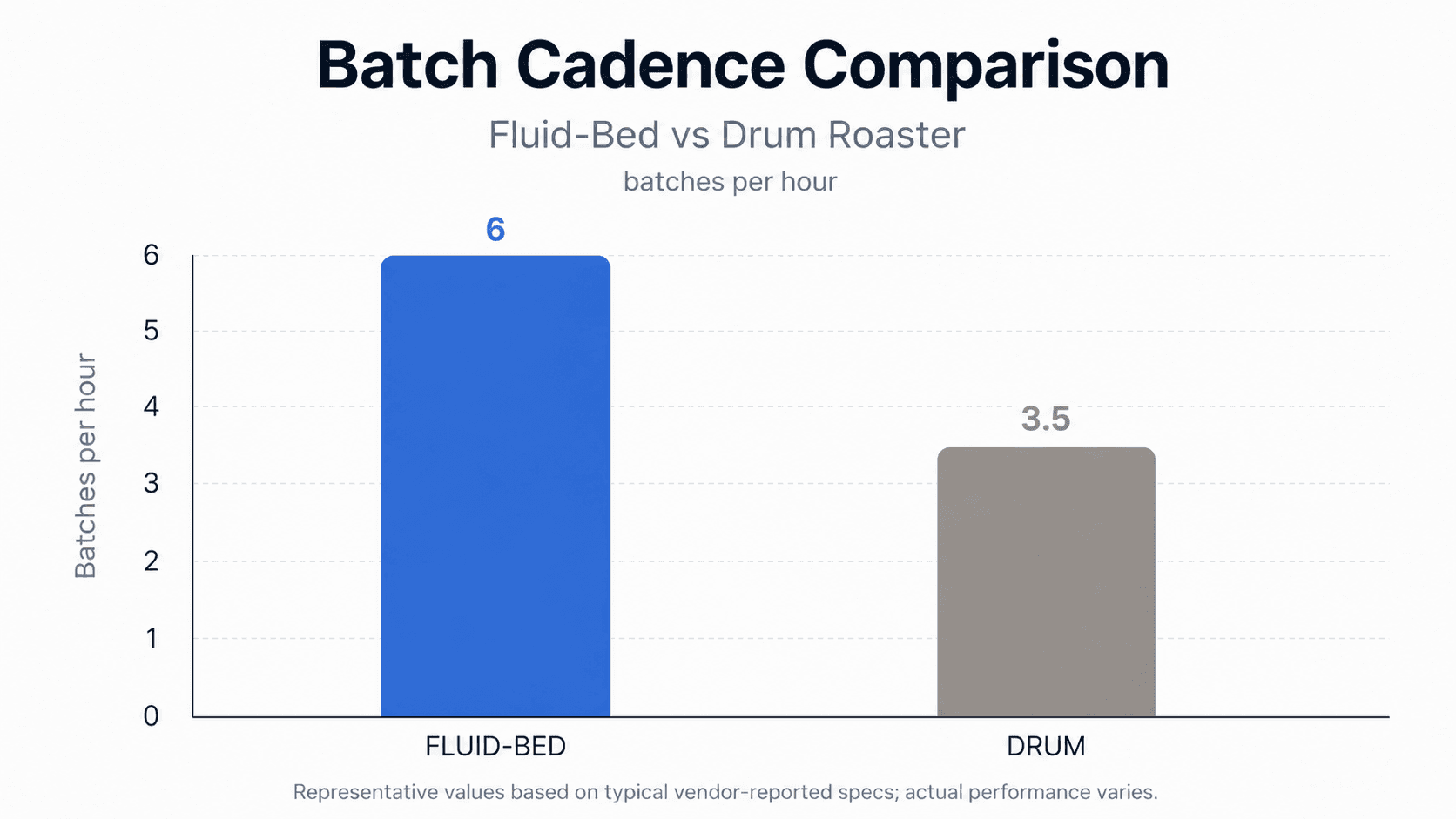
Up to 6 batches/hour
Around 0.3 kWh per kg of roasted coffee
5 PRO
5 kg batch
30 kg/h production
5–7 minute roasts
About 0.3 kWh/kg
10–30 kg industrial models
60–180 kg/h production
5–7 minute roasts
Similar energy usage per kg (~0.3 kWh/kg)
For a roastery, that’s a substantial energy‑cost and sustainability advantage over many traditional setups.
Here’s how fluid‑bed throughput stacks up against classic drum roasting cadence.
How Fluid‑Bed Roasting Reduces Common Roast Defects
Roast defect research and engineering papers consistently point to one key culprit: overheated metal surfaces and uneven heat application.
Loring’s technical paper, for example, notes that:
Scorching and facing are mainly caused by contact with overheated metal surfaces.
Tipping often occurs when beans are roasted too aggressively and unevenly.
Why fluid‑bed design helps
Because beans are lifted by air and not pressed against a hot drum:
There is far less opportunity for scorching or facing from direct metal contact.
Constant bean circulation reduces localized overheats on the bean surface.
Temperature changes are driven by airflow and heater control—not thermal inertia in thick steel.
In practice, this means fluid‑bed roasters like Typhoon are engineered to minimize:
Scorching
Tipping
Facing
Baked or flat profiles from sluggish heat transfer
A sensory/chemical study of roast defects showed: the “normal” (defect‑free) roast was significantly preferred over scorched, baked, or underdeveloped coffees. So every defect you avoid is a direct win in perceived cup quality.
Flavor Clarity and Cup Character on Fluid‑Bed Roasters
What does hot‑air roasting do to flavor?
Because of more even heat and fewer metal‑contact defects, many roasters report:
Higher flavor clarity
Cleaner sweetness
More distinct acidity
In other words, origin character tends to show through clearly when you’re not fighting scorched or flat notes.
A recent study on roaster type and roast level (using Robusta) found that roasting conditions changed:
Water content
Bulk density
Color
Aroma, bitterness, acidity, sweetness
Caffeine, however, didn’t change significantly—so any difference you taste between drum and fluid‑bed is more about flavor chemistry, not caffeine level.
Roast speed and profile discipline still matter
A 2020 study on roast speed and roaster type found that:
Roast speed
Roaster design
Green coffee quality
…all significantly influenced the volatile compound profile.
This is an important takeaway: fluid‑bed technology makes repeatability easier, but it does not replace good profile design. You still need to:
Choose the right charge temperature.
Manage rate‑of‑rise and development time.
Adapt profiles to different densities and processing methods.
Repeatability and Automation: Why Software Matters
Repeatable curves, not just hot air
Modern fluid‑bed systems don’t just blow hot air and hope for the best.
They use:
Precise temperature sensors in the roast environment.
Independent control of blower (air speed) and heater (air temperature).
Software recipes that store time–temperature–airflow profiles.
One patented fluid‑bed system, for example, monitors roast temperature, compares it to a stored reference curve, and automatically adjusts heater and airflow to stay on track.
Typhoon’s platform follows the same logic:
You build a profile for a coffee.
Save it as a recipe.
Run highly repeatable batches with minimal manual intervention.
Why this matters as you scale
For café owners and growing roasteries, repeatability is a business issue, not just a nerdy roasting concern.
Automation helps you:
Train new staff faster (they follow saved recipes instead of learning everything by feel).
Maintain consistency across locations.
Reduce the risk of expensive bad batches.
This is especially relevant when you’re pushing 6–7 batches/hour on a Typhoon Shop PRO, versus the 3–4 batches/hour many drum roasters can sustain once you factor in cool‑down.
Electric Fluid‑Bed vs Gas Drum: Practical Trade‑Offs for Startups
If you’re choosing between an electric fluid‑bed coffee roaster and a gas drum for a startup roastery, here are the key trade‑offs.
Where electric fluid‑bed shines
No gas infrastructure
No gas line installation or permitting.
Often easier landlord negotiations and fewer local code hurdles.
Lower energy use per kg (on platforms like Typhoon)
Around 0.3 kWh/kg versus much higher typical usage in older electric/gas systems.
Strong sustainability story for your brand.
Higher throughput on smaller footprints
Up to 6 batches/hour with no dedicated cool‑down.
Ideal for in‑café roasting and compact roastery layouts.
In‑store theatre
Transparent chambers make roasting visible and engaging for guests.
Easy to integrate into a bar or retail floor as a centerpiece of your brand.
Where gas drums still appeal
Very large industrial capacities (hundreds of kg/h) from legacy lines.
Familiarity for old‑school roasters who prefer drums’ thermal inertia.
Established service networks in some markets.
But with brands like Typhoon, Loring, IMF, PROBAT, and Bellwether all pushing electric or convection‑led systems, the market is clearly moving toward more efficient, more controllable, lower‑emission roasting.
When a Fluid‑Bed Roaster Makes Sense for Your Café or Small Roastery
A commercial fluid‑bed coffee roaster is worth serious consideration if:
You want a compact commercial coffee roaster that can live inside your café.
You need higher hourly output without upgrading to a huge drum.
You care about defect‑free, specialty‑grade roasting with clean flavor.
You want to avoid gas infrastructure and lower your energy bill.
You are building a brand around transparency, innovation, and sustainability.
Examples:
A 2.5 kg Typhoon Shop PRO is a strong candidate for the best commercial fluid‑bed coffee roaster for a small roastery or specialty café that wants 10–15 kg/day to start, with room to scale.
A 5–10 kg Typhoon system fits regional roasteries that want 30–60 kg/h with fast batches and tight profile control.
FAQ: Fluid‑Bed Coffee Roasting
1. Is fluid‑bed coffee roasting better than drum roasting?
“Better” depends on your goals.
Fluid‑bed roasters offer:
More even heat and less metal contact, which can reduce scorching and tipping.
Faster heat transfer and shorter roast times.
Fully electric, low‑energy operation on platforms like Typhoon (~0.3 kWh/kg).
Drum roasters offer:
A familiar feel and workflow for many roasters.
Strong performance at very large industrial scales.
For many specialty cafés and small roasteries, an electric fluid‑bed system is the more efficient and future‑proof choice.
2. Does fluid‑bed roasting change the flavor of my coffee?
Yes, the roast system influences flavor.
Because fluid‑bed roasting delivers heat more evenly and reduces defects, many roasters report:
Cleaner cups
Higher clarity
More precise acidity and sweetness
However, final flavor still depends on:
Green coffee quality.
Roast profile (charge temp, rate‑of‑rise, development time).
Rest time and brewing method.
3. Will a fluid‑bed roaster be harder for my team to learn?
In practice, the opposite is often true.
Modern fluid‑bed roasters like Typhoon are built around:
Recipe storage for time/temperature/airflow curves.
Automation that tracks and reproduces profiles.
Transparent chambers that make phases easy to see.
This makes them accessible for newer roasters, while still giving experienced roasters plenty of control.
4. How does a fluid‑bed roaster handle back‑to‑back batches?
Because heat is stored in the airflow and heating elements—not a massive drum—fluid‑bed systems typically:
Need little to no dedicated cool‑down time.
Can run up to 6–7 batches/hour at their nominal batch size.
This is a big advantage if you roast several origins or blend components in one production block.
5. Are fully electric fluid‑bed roasters really more sustainable?
They can be.
For example, Typhoon reports around 0.3 kWh/kg energy usage.
Compared to many traditional setups—and especially when paired with renewable electricity—this can significantly lower:
Your carbon footprint.
Your operating cost per kg.
If your brand story includes sustainability, electric convection roasting is a strong fit.
If you’re considering moving from a gas drum to an electric fluid‑bed system, start by mapping your required kg/h, available power, and in‑café experience goals. From there, you can compare specific models—like Typhoon’s Shop PRO series—against your current setup and see whether twice the output, lower energy, and cleaner cups justify the switch for your business.