






Kaffee im Allgemeinen
Geschrieben von:

Typhoon Redaktion
Röstliebhaber
Electric roasting changes the way you think about emissions and odor control, but it does not remove the need for compliance.
Electric roasting changes the way you think about emissions and odor control, but it does not remove the need for compliance.
Within the first few minutes of operation, any coffee roaster—gas or electric—produces particulate matter (PM), volatile organic compounds (VOCs), organic acids, and visible smoke that must be managed.
Do electric roasters need afterburners?
In many cases, electric commercial coffee roasters do not need a traditional gas-fired afterburner, but they still need some form of emissions and odor control.
Electric systems remove burner combustion emissions from the equation.
Roasting emissions (chaff, PM, VOCs, organic acids) are still present and can trigger local requirements for oxidizers or filters.
Depending on jurisdiction and batch size, you may use cyclones, high-efficiency filters, or catalytic oxidizers instead of a conventional thermal afterburner.
The result is usually simpler permitting and lower fuel-system complexity, not a complete absence of exhaust hardware.
Electric coffee roaster vs gas drum roaster: emissions basics
The U.S. EPA’s AP-42 notes that coffee roasting emits:
Particulate matter (PM) from chaff and bean fragments.
VOCs and organic acids from pyrolysis of organics inside the beans.
Combustion products (CO, NOx, CO₂) when burners are present.
These emissions are typically controlled using cyclones plus thermal or thermal-catalytic oxidizers downstream of the roaster exhaust, even in gas-based systems.[^epa]
With a fully electric fluid-bed roaster like Typhoon:
There is no open flame and no burner-related combustion gases in the roasting chamber.
The main emission sources are coffee-derived PM, VOCs, organic acids, and odor.
You can often meet odor and visible smoke requirements using high-efficiency filtration and targeted oxidation, rather than a large, dedicated afterburner.
[^epa]: U.S. EPA, AP-42 Section 9.13.2 Coffee Roasting, emissions and control technologies overview.
Afterburner for coffee roaster: what it does and why it’s costly
An afterburner for a coffee roaster is a thermal oxidizer that heats exhaust gases to high temperatures to oxidize VOCs, CO, and odors.
Key points:
Typical thermal oxidizers require ~750°C or higher inlet temperatures to achieve high conversion of VOCs and CO.[^catalytic]
This temperature is usually maintained by a dedicated burner that consumes significant fuel.
Hardware, installation, ducting, and permits can add a major cost layer on top of the roaster itself.
Coffee roaster afterburner cost
Public listings give a sense of current market pricing:
A new Selkirk thermal oxidizer paired with a Giesen W15A (15 kg drum roaster) was listed at $24,500 USD on CoffeeTec in 2024.[^coffeetec]
A used Probat afterburner listing noted that the original new price was well over $30,000 USD for the unit.[^coffeetec]
Important caveats:
Pricing varies by capacity, brand, configuration (thermal vs catalytic), and new vs used.
These figures exclude ducting, stack, installation, fuel lines, and permitting fees.
In many projects, the emission-control system can easily represent 20–40% of the total plant capex.
[^coffeetec]: CoffeeTec equipment listings for Giesen W15A + Selkirk oxidizer and Probat afterburner, accessed 2024.
Thermal oxidizer for coffee roaster vs catalytic oxidizer
A thermal oxidizer and a catalytic oxidizer both aim to destroy VOCs and odors, but they operate at very different temperatures.
Thermal oxidizer (classic afterburner)
Operates at ~750°C or above to achieve high conversion of VOCs and CO.[^catalytic]
Requires substantial auxiliary fuel (natural gas, LPG).
Increases operating cost and adds burner permitting.
Catalytic oxidizer
Recent research on a 5 kg drum roaster found:[^catalytic]
A platinum-based catalyst at 350°C inlet temperature achieved ≈96% CO conversion.
The same setup achieved ≈78% VOC conversion.
Because catalytic oxidation works at lower temperatures, it can be more energy-efficient and reduce fuel consumption compared with a thermal afterburner.
For specialty roasteries:
Catalytic oxidizers can be an attractive alternative where VOC loads are moderate.
Electric roasters without burner emissions can pair particularly well with catalytic solutions or advanced filtration, minimizing total fuel use.
[^catalytic]: Academic study on catalytic oxidation in coffee roasting exhaust, 2026, reporting ≈96% CO and ≈78% VOC conversion at ~350°C; contrasts with >750°C needs for conventional thermal oxidation.
How electric roasting changes the emissions equation
Electric roasters like Typhoon remove gas lines and open flames, but emissions control still matters.
What electric roasters change
No burner combustion inside the roasting chamber.
Simplified permitting in many jurisdictions (no gas supply, burner permits, or flame safety requirements).[^^typhoon-install]
Opportunity to use lower-complexity filtration systems where regulations allow.
What electric roasters do not change
Coffee roasting still generates PM, VOCs, organic acids, and odors.[^epa]
Many authorities still require exhaust ducting, odor control, and noise management.[^^typhoon-install]
Larger production roasters may still need oxidizers or advanced filters depending on local rules.
Typhoon’s installation guidance explicitly notes that electric roasters simplify approvals by removing gas lines and open flames but still require three‑phase power, ducting, odor control, and sometimes environmental permits.[^^typhoon-install]
[^^typhoon-install]: Typhoon Coffee, Electric coffee roaster: installation requirements blog, outlining power, exhaust, odor, and permitting needs.
Typhoon’s electric fluid‑bed platform: performance and control
Typhoon’s shop and industrial roasters share the same electric fluid‑bed convection technology.
Performance figures below are manufacturer specifications measured under typical production conditions (5–7 minute roast times, standard specialty-grade Arabica beans, medium roast profiles):
Typhoon 2.5 PRO: up to 15 kg/h, 5–7 min roast time, about 0.3 kWh/kg energy use, up to 6 batches/hour at full load.[^typhoon-25]
Typhoon 10 PRO: up to 60 kg/h at similar 5–7 minute roast durations and ≈0.3 kWh/kg.[^typhoon-10]
Typhoon 20 kg system: listed performance up to 100–120 kg/h, again at ≈0.3 kWh/kg and fully electric with no open flame.[^typhoon-20]
These numbers are based on Typhoon’s internal testing:
Repeated production roasts of washed Arabica lots at nominal batch capacity.
Energy measurements via onboard metering averaged across multiple batches.
Validation through factory pre‑shipment testing (~20 test roasts per machine) for each model.
[^typhoon-25]: Typhoon Coffee, Typhoon 2.5 PRO product page, performance and energy figures. [^typhoon-10]: Typhoon Coffee, Typhoon 10 PRO product page, capacity and energy data. [^typhoon-20]: Typhoon Coffee, Typhoon 20 kg roaster page, listed output and electric design.
Typhoon Air Filter and particulate control
For 10–30 kg systems, Typhoon offers the Typhoon Air Filter, a dedicated filtration solution.
According to Typhoon’s specifications:[^typhoon-filter]
The unit captures up to 99.5% of fine particles and roasting emissions by mass.
It is designed to integrate with Typhoon 10–30 kg roasters.
Testing is based on measured PM mass concentration at the filter inlet and outlet under continuous roasting of typical production batches.
Typhoon notes that some customers have reported up to 50% energy savings versus their previous roasting setup; this is an anecdotal customer report, not a controlled comparative study, and actual savings depend on the replaced equipment and local energy tariffs.[^typhoon-filter]
[^typhoon-filter]: Typhoon Coffee, Typhoon Air Filter product and testimonial page, stating up to 99.5% particulate capture and anecdotal energy-savings reports.
ESP vs baghouse vs cyclone: particulate and odor control options
When planning emissions control around any roaster, you’ll typically consider combinations of:
Cyclone
Uses centrifugal force to remove larger particulates and chaff.
Typical capture efficiency: 70–95% for coarse particles; lower for very fine PM.[^epa]
Often used as a primary stage before further filtration or oxidation.
Baghouse (fabric filter)
Uses filter bags to capture fine particulate matter.
Properly designed baghouses can exceed 99% PM capture efficiency in industrial contexts.
Requires periodic bag cleaning/replacement and consistent maintenance.
Electrostatic precipitator (ESP)
Charges particles electrically and collects them on plates.
Can achieve high fine-PM capture efficiency with relatively low pressure drop.
Requires high-voltage power supplies and regular plate cleaning.
In coffee roasting:
Cyclones are common for chaff removal.
Baghouses or ESPs are used where fine PM and visible smoke must be minimized.
Systems may be combined with thermal or catalytic oxidizers for VOC and odor destruction.
Coffee roaster odor regulations — Europe
European and UK regulations focus on odor, VOCs, and nuisance complaints, often via broader air-quality and industrial-emissions frameworks rather than coffee-specific rules.
Common patterns include:
Local permitting based on roaster size, daily throughput, and location (mixed-use vs industrial).
Requirements for odor abatement (thermal or catalytic oxidizers, filters) when operations generate complaints.
Emphasis on best available techniques (BAT) for small/medium combustion and industrial processes.
Examples:
Many EU cities treat coffee roasting under general industrial odor/nuisance ordinances, requiring stack height and abatement if neighbors report issues.
UK local authorities may require roasteries to install odor-control equipment and comply with guidance under the Environmental Permitting (England and Wales) Regulations, especially for larger batch sizes.
For specialty roasteries inside cafés or mixed-use buildings, the practical implication is:
You must plan for adequate stack height, filtration, and possibly catalytic oxidation.
Electric roasters help by removing gas burner permitting, but complaints can still drive requirements for odor abatement.
Ventilation requirements for coffee roasters
Regardless of fuel type, coffee roasters need proper ventilation and exhaust ducting.
Key considerations:
Stack height sufficient to disperse exhaust above nearby rooflines and avoid re-entrainment.
Ducting sized for roaster airflow; manufacturers typically specify required CFM (or m³/h).
Compliance with local mechanical codes and, where applicable, commercial kitchen ventilation standards.
Practical steps:
Work with an HVAC engineer to size ducting, fans, and stacks for your specific roaster and building.
Confirm with local environmental or building authorities whether your operation needs additional odor control beyond the roaster’s built-in cyclones or filters.
Plan for noise control (fans, stacks, oxidizers) in urban settings.
Typhoon’s installation guidance emphasizes:
Exhaust ducting to the outside.
Consideration of noise, odor, and neighbor proximity.[^^typhoon-install]
Typhoon Roasters vs Loring emissions
Loring is a well-known competitor focused on energy-efficient, semi-recuperative gas roasting with integrated thermal oxidizers.
Typhoon and Loring approach emissions differently:
Typhoon Roasters
Fully electric fluid-bed systems.
Use 0.3 kWh/kg energy (manufacturer spec) and have no open flame.[^typhoon-25][^typhoon-10][^typhoon-20]
Emissions control via cyclones, Typhoon Air Filter, and optional oxidizers depending on jurisdiction.
Loring roasters (general industry understanding)
Use gas burners with integrated thermal oxidizers and heat recirculation.
Reduce overall fuel use compared with classic drum + separate afterburner.
Still require gas infrastructure and burner permitting.
Because Loring’s detailed emission numbers (VOCs, PM, energy per kg) are proprietary or model-specific, direct numerical comparisons are limited.
From an emissions-control perspective:
Typhoon’s electric platform removes gas combustion from the roaster itself and can pair with modular filtration.
Loring’s integrated oxidizer simplifies control within a gas-based system but maintains burner-related permitting and fuel use.
Real-world Typhoon installations: simplifying emissions and compliance
Typhoon’s installed base highlights how electric roasting can reduce complexity:
Courtyard café in Flensburg, Germany (Onoma Kaffee)
Typhoon’s client profile for Onoma Kaffee shows a courtyard café-roastery where:
Electric roasting avoids gas lines and open flames in a mixed-use setting.[^onoma]
Exhaust and odor control are handled via ducting and filtration, suitable for the surrounding residential context.
Soundproofed café-roastery in Illinois, USA
A U.S. client case describes a soundproofed roasting room inside a café:
Electric roasters simplify local fire and building approvals.
Filtration and ducting are designed to minimize odor and noise complaints.
Urban installations in Qatar and Dubai
Typhoon’s client stories in Qatar and Dubai emphasize:
Electric roasters inside malls or urban complexes, where gas infrastructure is difficult to justify.[^onoma]
Compact exhaust solutions and low-emission roasting theatre in customer-facing spaces.
These case studies illustrate that electric roasting can:
Reduce fuel-system dependencies.
Make in‑store roasting more feasible.
Shift the compliance focus to odor, PM, and neighbor experience, rather than gas lines and burner safety.
[^onoma]: Typhoon Coffee, client pages including Onoma Kaffee (Flensburg) and urban installations in Qatar/Dubai, highlighting electric roasting in mixed-use settings.
U.S. regulatory examples: electric helps, oxidizers still matter
Different U.S. jurisdictions illustrate how electric vs gas affects permits, but not the need for control hardware.
Vermont DEC — coffee roasters
The Vermont Department of Environmental Conservation notes:[^vt]
Facilities roasting under 1 million pounds of green coffee per year often do not require an air permit.
However, production roasters may still need catalytic or thermal oxidizers for emissions control, even without a formal air permit.
Puget Sound Clean Air Agency (Washington)
Puget Sound Clean Air’s General Order for coffee roasters states:[^ps]
Roasters under 26.5 lb per batch and 950 lb/day may qualify for a General Order instead of a full permit.
Emissions from the roaster and cooling tray must still be controlled by a thermal or catalytic oxidizer.
South Coast AQMD / AirQuality.org (California)
Guidance for coffee roasting operations in California notes:[^ca]
Drum roasters with cyclones usually require a permit above 18 lb batch size.
Floating-bed roasters generally trigger permitting above 12 lb batch.
Afterburners ≥1 MMBtu/hr need separate permit applications.
These examples show:
Electric roasters can reduce burner-related permitting thresholds.
But oxidizers, filters, and ducting remain central to compliance—even at smaller capacities.
[^vt]: Vermont DEC, Coffee Roasters source category guidance, thresholds around 1 million lb/year and oxidizer expectations. [^ps]: Puget Sound Clean Air Agency, Coffee Roaster General Order background document, March 2022, batch and daily throughput limits and oxidizer requirements. [^ca]: South Coast AQMD / AirQuality.org, Coffee Bean Roasting Operations permit guidance, batch and afterburner thresholds.
How Typhoon simplifies emissions and odor control in practice
For many café-roasteries and micro-roasteries, Typhoon’s electric platform offers a more straightforward path:
No gas lines or burners inside the roasting chamber.
Lower energy intensity (≈0.3 kWh/kg) compared with many traditional drum-and-afterburner setups.[^typhoon-25][^typhoon-10][^typhoon-20]
Ability to pair roasters with Typhoon Air Filter or other filtration solutions instead of a large thermal afterburner.[^typhoon-filter]
In practical terms, this can mean:
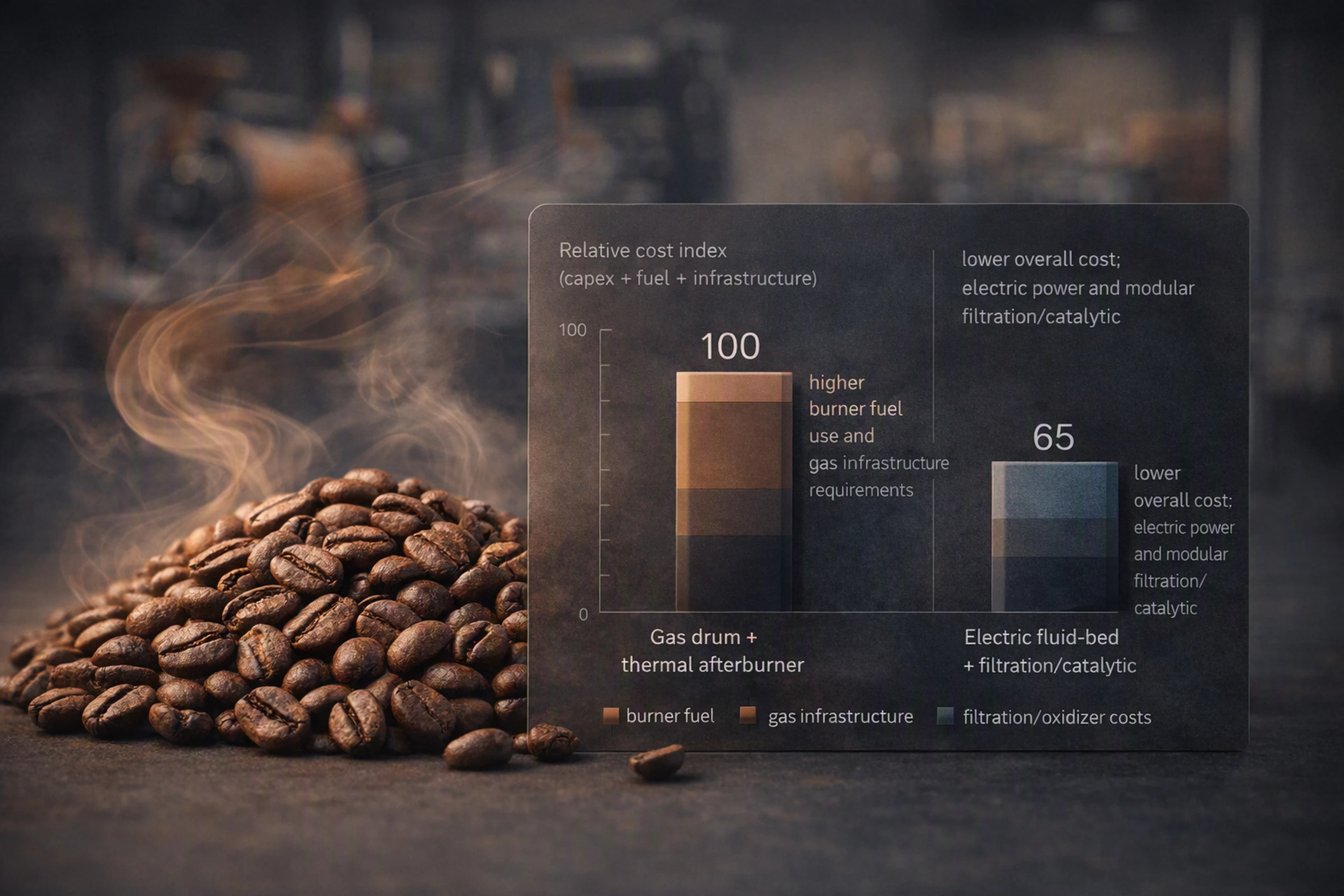
Lower capex on emissions hardware (filters vs big oxidizers), depending on local requirements.
Simpler installation in cafes, malls, and mixed-use spaces.
Shorter ROI periods, as energy and infrastructure costs drop.
Here’s how the trade-offs often play out.
Actionable steps for planning your roastery’s emissions strategy
If you’re evaluating electric roasters vs afterburners, consider this checklist:
Clarify your capacity
Peak kg/h, typical daily volume, and batch size.
Whether roasting happens inside a café or in an industrial space.
Map local regulations
Talk to your local environmental agency about thresholds for permits, oxidizers, and odor control.
Ask specifically about electric roaster installations and whether catalytic or filtration-only solutions are acceptable.
Compare equipment options
Evaluate fully electric roasters (like Typhoon) vs gas drum systems with integrated or separate oxidizers.
Factor in energy per kg, capex, and installation complexity.
Design ventilation and odor control together
Work with HVAC and environmental engineers to size ducting, stacks, and fans.
Decide whether you need cyclone only, cyclone + filter, or cyclone + oxidizer.
Think about brand and customer experience
If roasting in-store, prioritize low-odor, low-noise, visually engaging equipment.
Electric fluid-bed roasters can make roasting theatre part of your brand story.
Typhoon Roasters actively supports roastery planning with equipment selection, installation guidance, and emissions-control options, helping specialty businesses transition to a future-proof, electric platform.
FAQ: Electric roasters, afterburners, and odor control
Do electric coffee roasters produce fewer emissions than gas drum roasters?
Electric roasters remove burner combustion emissions, but coffee-derived PM, VOCs, organic acids, and odors are similar for a given roast profile.
The main difference is that electric systems don’t add burner-related NOx and CO from gas combustion.[^epa]
If I install a Typhoon electric roaster, will I still need an afterburner?
It depends on your jurisdiction, batch size, and location.
Many small roasteries can meet requirements with cyclones and filtration (e.g., Typhoon Air Filter), while larger plants or stricter regions still require catalytic or thermal oxidizers.
What is the payback on switching from a gas drum roaster with afterburner to an electric system?
Payback varies by energy prices, usage, and existing infrastructure.
Typhoon positions its systems around rapid ROI (often months rather than years) thanks to lower energy use (~0.3 kWh/kg) and reduced gas infrastructure, but your actual numbers will depend on local costs and throughput.
Are odor complaints still an issue with electric roasters inside cafés?
Yes, they can be.
Electric roasters still produce coffee odors and some visible exhaust, so you must plan for ducting, stack height, and odor abatement—especially in dense urban areas.
How do I choose between a baghouse, ESP, or oxidizer for my roastery?
Start by:
Assessing your PM and VOC load (capacity and roast style).
Checking local rules for visible emissions and odor.
Considering maintenance and operating cost.
Cyclones are common for chaff; baghouses or ESPs handle fine PM; catalytic or thermal oxidizers manage VOCs and odor when required.
Electric roasting doesn’t make emissions disappear—but it does allow you to simplify your setup, cut fuel use, and focus control hardware where it matters most.
If you want to explore how a Typhoon electric fluid‑bed system could transform your roastery’s emissions profile and customer experience, our team can help you model capacity, control options, and ROI for your specific site.