






Káva obecně

Napsáno:

Typhoon Editorial
Milovníci pražení
Electric roasting has moved from niche to mainstream. For growing roasteries, it’s now a serious path to higher throughput, lower energy use, and more…
Meta description: Learn how to scale a roastery from 15 kg/h to 100 kg/h using the best electric commercial coffee roaster setup, including batch size strategy, scheduling, and automation.
How to Scale a Roastery from 15 to 100 kg/h
Electric roasting has moved from niche to mainstream. For growing roasteries, it’s now a serious path to higher throughput, lower energy use, and more predictable production.
This guide walks through how to scale a roastery from 15 kg/h to 100 kg/h using electric commercial coffee roasters, with a focus on Typhoon Roasters’ fluid‑bed platform.
We’ll cover:
Electric coffee roaster capacity (kg per hour) and what the numbers really mean
Batch size strategy from café scale to industrial output
Scheduling and throughput planning for roasteries
Roast automation systems and workflow continuity
A worked ROI example and what “stepped capacity growth” looks like in practice
TL;DR: Key Takeaways for Scaling Electric Throughput
Typhoon 2.5 PRO: ~15 kg/h
Typhoon 5 PRO: ~30 kg/h
Typhoon 10 PRO: ~60 kg/h
Typhoon 20 kg: ~100 kg/h
All are fully electric, fluid‑bed commercial roasters with 5–7 minute roast times and up to ~6 batches/hour when operators run near full capacity.
These models make it practical to move from 15 to 100 kg/h in steps, instead of jumping directly from a small shop roaster to a large industrial roaster.
Electric Coffee Roaster Capacity (kg per hour): How to Read the Numbers
When you compare electric coffee roaster capacity (kg per hour), it’s important to understand the assumptions behind each figure.
Typhoon Roasters capacity ladder
According to Typhoon’s published specifications (Typhoon Roasters):
Typhoon 2.5 PRO
Nominal batch: 2.5 kg
Throughput: 15 kg/h
Typical roast time: 5–7 minutes per batch
Electrical: 23A, 380–400V
Typhoon 5 PRO
Nominal batch: 5 kg
Throughput: 30 kg/h
Typical roast time: 5–7 minutes
Electrical: 38A, 380–400V
Typhoon 10 PRO
Nominal batch: 10 kg
Throughput: 60 kg/h
Typical roast time: 5–7 minutes
Electrical: 69A, 380–400V
Includes automatic loading, airflow and exhaust control (Typhoon Roasters)
Typhoon 20 kg
Nominal batch: 20 kg
Throughput: 100 kg/h
Typical roast time: 5–7 minutes
Electrical: 98A, 380–400V
Fully automatic control for continuous production (Typhoon Roasters)
Typhoon 30 kg
Nominal batch: 30 kg
Throughput: 180 kg/h
Typical roast time: 5–7 minutes
Electrical: 210A, 380–400V (Typhoon Roasters)
What “up to 6 batches/hour” actually assumes
Typhoon’s stated 15–180 kg/h capacities assume roughly:
5–7 minutes roast time per batch
Minimal idle time between batches
Fast loading and post‑roast handling
An operator working with prepared greens and labels
In practice, your real‑world throughput depends on:
Bean type (dense washed coffees vs naturals)
Desired roast level (light vs dark)
Cooling and bagging speed
Staffing and scheduling discipline
Typhoon’s fluid‑bed convection technology allows roasting and cooling to happen in parallel, so there is no separate dedicated cool‑down cycle between batches. Cooling still takes time, but it doesn’t block the roasting chamber from starting the next batch.
Why Electric Fluid‑Bed Roasters Scale Differently
Convection‑driven roasting (with caveats)
Typhoon’s platform is built around patented fluid‑bed convection technology, using a controlled stream of hot air to heat the bean mass evenly.
Heat transfer is primarily convective, with much less direct contact heating than in classic gas drum roasters.
This reduces common defects like scorching and tipping and helps keep internal gradients lower (Typhoon Roasters).
“100% convection” in marketing terms means the primary heat delivery is via hot air, but in any real roaster there are minor conductive and radiative effects. Operationally, you can think of Typhoon as a fluid‑bed roaster that behaves like a controlled hot‑air oven, not a gas‑heated rotating drum.
Energy efficiency and electrification
Typhoon reports an energy use of ~0.3 kWh per kg of roasted coffee on its fully electric roasters (Typhoon Roasters).
Many traditional gas drum setups, when you include burner efficiency and ancillary fans, often land around 0.9 kWh/kg or equivalent energy input. That’s why Typhoon positions its roasters as using roughly 3× less energy per kg than many conventional systems.
Exact comparisons depend on:
Local gas and electricity prices
Burner tuning and maintenance
Ventilation and afterburner use
But if your electricity is competitively priced—or increasingly renewable—electric fluid‑bed roasting can be both a cost and sustainability advantage.
Stepped Capacity Growth: A Roadmap from 15 to 100 kg/h
One of the biggest risks in roastery expansion is over‑investing in capacity too early. Typhoon’s product line is unusually “stepwise” for electric roasting, making it easier to grow in logical increments.
Step 1: 15 kg/h — Early‑stage roastery or café roaster
Best fit:
Single café roasting in‑house
Micro‑roastery doing up to 100–150 kg/week
Typical setup:
Typhoon 2.5 PRO
2–3 production days per week
4–5 batches per production day (light schedule)
This is a safe starting point if you’re validating your brand, dialing in profiles, and building local wholesale volume.
Step 2: 30 kg/h — Growing local roastery
Once you consistently hit 150–300 kg/week, a move to 30 kg/h often makes sense.
Typical setup:
Typhoon 5 PRO
2–3 production days per week
6–10 batches per day
You now have room for:
More SKUs (decaf, seasonal lots)
Better batching (full 5 kg loads)
A buffer for wholesale growth without weekend overflow roasting
Step 3: 60 kg/h — Regional roastery entering multi‑location distribution
When you reach 300–700 kg/week, bottlenecks tend to show up in:
Between‑batch workflows
Cooling and packaging
Staff fatigue
This is where a Typhoon 10 PRO (60 kg/h) with automatic loading and exhaust control becomes meaningful. At this tier, a single 8‑hour shift can roast about 480 kg of coffee if you maintain near full utilization (60 kg/h × 8 h = 480 kg) (Typhoon Roasters).
Step 4: 100 kg/h — Established regional roastery
At 700–1,500+ kg/week, you’re in true production territory. A Typhoon 20 kg (100 kg/h) can roast around 800 kg per 8‑hour shift at full utilization (100 kg/h × 8 h = 800 kg) (Typhoon Roasters).
This is appropriate when:
You supply multiple café locations or supermarket chains
You run at least 3–4 production days per week
You have staff dedicated to production, packaging, and QC
Thanks to shared UI and profile logic across Typhoon models, your operators don’t have to relearn a new roasting language as you move up the ladder.
Batch Size Strategy for Commercial Coffee Roasting
Why batch size matters
Batch size is your primary lever for balancing:
Roast consistency
SKU flexibility
Production throughput
For commercial fluid‑bed coffee roasters like Typhoon, ideal batch sizes are generally 70–100% of nominal capacity. Batching too small can:
Waste energy
Introduce more variability in bean lofting and heat transfer
Practical batch size strategy at each tier
On a 2.5 PRO (15 kg/h)
Target 2.0–2.5 kg batches
Use smaller batches only for R&D or ultra‑limited lots
On a 5 PRO (30 kg/h)
Target 4–5 kg batches
Keep standard blends at full 5 kg to simplify scheduling
On a 10 PRO (60 kg/h)
Target 8–10 kg batches
Use automation for consistent loading weights
On a 20 kg (100 kg/h)
Target 16–20 kg batches
Align batch size with packaging formats (e.g., multiples of your most common bag size)
Integrating batch size with product mix
To keep a sane workflow:
Group roasts by process and roast level (e.g., all washed espresso roasts together)
Avoid constant batch size changes within a production block
Use your reference profiles as anchors and plan batch sizes around them
Cropster’s scheduling guidance, for example, explicitly focuses on the number of batches needed and optimal batch size per order set (Cropster).
Scheduling and Throughput Planning for Roasteries
From ad‑hoc roasting to demand‑led production
Moving from ad‑hoc roasting to order‑led scheduling is one of the biggest performance gains for any roastery.
Cropster reports that a 750 kg/week roastery recovered ~20 hours per month after shifting from manual planning to demand‑led scheduling tied to orders and inventory (Cropster).
Core scheduling questions to answer
For each production week:
How many kg must we roast?
Which SKUs, and in what batch size?
Which roaster is best for each SKU?
How many batches does that represent per roaster?
What is the ideal sequence to minimize changeovers and downtime?
Typical scheduling pattern at different capacities
At 15–30 kg/h
1–2 roast days/week
6–12 batches/day
Manual scheduling in spreadsheets or simple software
At 60 kg/h
2–4 roast days/week
20–30 batches/week
Order‑driven schedules using tools like Cropster or Giesen Profiler
At 100 kg/h
3–5 roast days/week
40–60+ batches/week
Dedicated production planning, batch grouping, and between‑batch protocols
Cropster’s Between Batch Protocol suggests many roasteries can move from 2–3 to 3–4 batches/hour just by tightening between‑batch workflows (Cropster). Typhoon’s fast fluid‑bed roaster and no‑cooldown requirement make those gains even more accessible.
Roast Automation Systems for Commercial Roasters
What “automation” means in practice
Electric commercial roasters now commonly include:
Profile storage and replay (time, temperature, airflow curves)
Automatic loading and discharge
Airflow and exhaust control
Integration with planning software (e.g., Cropster, Artisan)
Typhoon’s 10 PRO, 20 kg and 30 kg models add automatic loading and fully automatic roasting control, turning recipes into consistent, repeatable batches while still allowing manual override (Typhoon Roasters).
Why automation matters when scaling
Automation supports scaling by:
Reducing operator variability
Lowering training time for new staff
Making it easier to replicate profiles across multiple roasters
PROBAT, Giesen, Coffee‑Tech and Typhoon all lean on profile transfer and electric/hybrid heating to keep flavour profiles consistent when you upgrade equipment (PROBAT, Giesen, Coffee‑Tech).
Sample ROI & Payback Scenario (with Assumptions)
Typhoon often speaks about fast ROI for growing roasteries. Instead of broad claims, here’s a simple example you can adapt.
Assumptions table
Let’s compare moving from 15 kg/h (Typhoon 2.5 PRO) to 60 kg/h (Typhoon 10 PRO).
Capacity & utilization
2.5 PRO capacity: 15 kg/h
10 PRO capacity: 60 kg/h
Utilization rate (production): 60% of max
Production days/month: 16 days
Hours/day on roaster: 6 hours
Economics
Green coffee margin: €3 per kg roasted (net contribution after COGS)
Electricity cost: €0.20 per kWh
Typhoon energy use: 0.3 kWh/kg (Typhoon Roasters)
Labor cost: €20 per hour (loaded)
Equipment cost (illustrative only)
2.5 PRO sunk cost
10 PRO capital cost: €45,000 (example, actual pricing varies by region and options)
Throughput comparison
At 60% utilization:
2.5 PRO
15 kg/h × 6 h/day × 16 days = 1,440 kg/month
10 PRO
60 kg/h × 6 h/day × 16 days = 5,760 kg/month
Incremental monthly capacity gain:
5,760 kg − 1,440 kg = 4,320 kg/month additional potential
Profit and payback approximation
Incremental profit from extra capacity, if you can sell it:
4,320 kg × €3/kg margin = €12,960/month gross contribution
Incremental energy cost:
4,320 kg × 0.3 kWh/kg = 1,296 kWh/month
1,296 kWh × €0.20/kWh = €259/month
Labor impact will depend on your staffing model. If you’re already running a roaster for those hours, the main change is more output per paid hour.
Simple payback period:
Equipment: €45,000
Net incremental margin ≈ €12,960 − €259 ≈ €12,700/month
Payback ≈ €45,000 ÷ €12,700 ≈ 3.5 months
This example assumes:
You can actually sell the extra volume
Existing space and permitting can support the larger roaster
Other bottlenecks (packaging, storage) are addressed
Your real ROI will vary with:
Local energy prices
Actual equipment cost
Sales velocity
Labor structure
Use this as a template, not a forecast.
Typhoon Roasters vs Loring Smart Roast: Sustainability Context
Many roasteries compare Typhoon Roasters vs Loring Smart Roast when evaluating sustainability. While detailed spec‑by‑spec comparison is beyond this article, here’s the high‑level context.
Fuel type
Typhoon: fully electric fluid‑bed roasters
Loring: gas‑fired drum/convection systems with integrated burners
Energy narrative
Typhoon: ~0.3 kWh/kg electric use and claims of ~3× less energy per kg than many gas drum roasters (Typhoon Roasters)
Loring: focus on high gas efficiency and integrated roasting/afterburner to lower gas use per kg compared with traditional drum setups
Decarbonization options
Typhoon: can run on renewable electricity contracts or on‑site solar
Loring: can benefit from lower‑carbon gas sources but still relies on combustion
In short, Typhoon’s sustainability story is tied to electrification and low kWh/kg, while Loring’s is tied to high gas efficiency and integrated emissions control.
Loring®, PROBAT®, Giesen®, and Diedrich® are trademarks of their respective owners. Typhoon Roasters is not affiliated with, sponsored by, or endorsed by any of these companies.
Electric Coffee Roaster vs Gas Drum for Roastery Startups
For startups comparing electric coffee roaster vs gas drum roastery startup options, the decision often comes down to infrastructure and flexibility.
Electric advantages
No gas line installation or burner tuning
Easier siting in mixed‑use buildings (subject to local code)
Simpler multi‑site replication (same electrical spec, similar controls)
Drum/gas advantages
Broadly familiar to many roasters
Long heritage and a large installed base
If you value:
Lower energy per kg
No dependence on gas
Consistency and faster roast cycles
Electric fluid‑bed platforms like Typhoon, PROBAT’s P‑series electric models, Giesen W6E/W15E, or Coffee‑Tech’s shop roasters are all strong contenders (PROBAT, Giesen, Coffee‑Tech).
Typhoon Roasters Coffee Roaster Reviews & Operator Feedback
Public Typhoon Roasters coffee roaster reviews tend to emphasize:
Clean, defect‑free cups
Fast roast cycles and back‑to‑back roasting
Strong onboarding and support
Typhoon reports installations at 500+ roasteries worldwide and highlights:
Online roasting courses
Dedicated service managers
2‑year warranties
48‑point inspection and ~20 test roasts per machine before shipment (Typhoon Roasters).
For balanced research, roastery owners typically compare Typhoon with Probat, Giesen, Diedrich, Loring, IMF, and Coffee‑Tech, and read peer feedback on forums like r/coffee_roasters on Reddit (Reddit).
Infographic: Fluid‑Bed Scalability at a Glance
Here’s a quick visual of how Typhoon’s capacity ladder helps you scale without over‑investing.
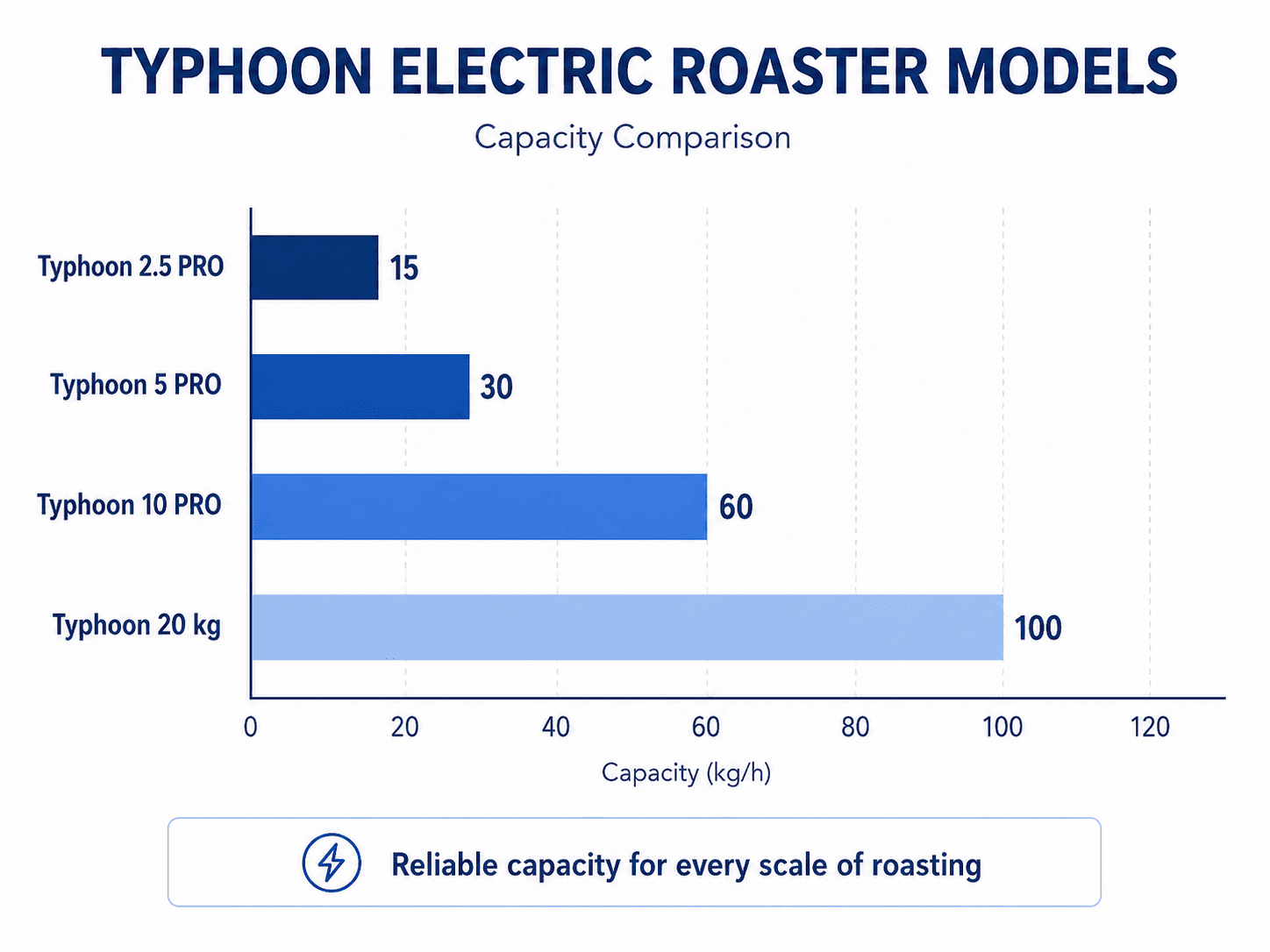
These incremental steps let you match capital expenditure to real demand instead of leaping straight from café scale to 100+ kg/h.
Permits, Ventilation, and Emissions: What Electric Roasting Does (and Doesn’t) Change
Electric simplifies fuel; it doesn’t erase emissions
Electric roasters remove:
Gas lines
Burners and open flames
But coffee roasting still produces:
Smoke and VOCs
Odors
Fine particulate matter
The US EPA and NIOSH both note that roasting can require controls such as afterburners or thermal oxidizers in some facilities, depending on volume and location (EPA).
Jurisdictional notes (high level)
Regulations vary widely, but generally:
EU
Local air‑quality rules may limit roasting emissions in dense urban areas
Expect requirements for proper ducting, filtration, and sometimes thermal treatment
US & Canada
City and state/provincial codes govern ventilation and air permits
Larger roasteries may need air permits and formal emission controls
Asia & other regions
Rules range from minimal to very strict depending on city/region
In all cases, you should:
Consult local building and fire codes
Check with environmental authorities about VOC and odor rules
Plan for adequate ducting, filtration, and possibly catalytic or thermal oxidizers
Electric roasters like Typhoon simplify fuel infrastructure and permitting, but you still need to address air handling and emissions appropriately.
Actionable Next Steps for Growing Roasteries
To move from 15 to 100 kg/h in a sane, profitable way:
Model your demand
Current weekly kg
12–24 month growth scenarios
Choose a capacity step
2.5 PRO (15 kg/h) for early validation
5 PRO (30 kg/h) for growing locals
10 PRO (60 kg/h) or 20 kg (100 kg/h) for regional production
Design your batch size strategy
Aim for 70–100% of nominal batch size
Tie batches to SKUs and packaging formats
Implement order‑led scheduling
Use planning tools (Cropster, similar) to tie roasts directly to orders
Standardize between‑batch protocols
Leverage automation
Use profile storage and replay
Automate loading and exhaust where available
Check permits and infrastructure early
Electrical supply and panel capacity
Ventilation and emission control requirements
Typhoon Roasters can help map your current demand to the right roaster size and future upgrades, keeping your workflow and software consistent as you grow.
FAQ: Scaling Production with Electric Roasters
1. How do I know if I should move from 15 kg/h to 30 kg/h?
If you regularly roast more than 150–300 kg/week, struggle to fit production into 1–2 days, or find yourself roasting on weekends, it’s time to consider moving from a 2.5 PRO (15 kg/h) to a 5 PRO (30 kg/h). Use your past 3–6 months of sales data to project forward and decide.
2. What is the best batch size strategy for a small roastery?
For a small roastery on a 5 kg electric roaster, aim for 4–5 kg batches for core products. Reserve smaller batches for limited lots and R&D. This keeps energy use efficient and simplifies scheduling.
3. Can I run a Typhoon roaster inside my café?
Many Typhoon Shop PRO installations are inside cafés. However, you must comply with local building, fire, and air‑quality regulations, including proper ducting and, if required, odor and VOC control. Electric roasting helps with fuel safety, but emissions rules still apply.
4. Does electric roasting change flavour compared to gas drums?
Electric fluid‑bed roasting typically yields cleaner cups with fewer defects, thanks to more even convection heating. Flavour differences vs gas drums are mostly about heat transfer and profile design, not electricity vs gas per se. Most roasteries can match or improve their target flavour profiles with careful profile development.
5. How do Typhoon Roasters support scaling beyond equipment?
Typhoon offers:
Online roasting courses
Assistance with choosing the right roaster size
Dedicated service managers and 24‑hour response
Thorough pre‑shipment testing of each machine
This makes them a partner in building your roastery, not just an equipment supplier (Typhoon Roasters).
If you’d like a capacity and ROI model tailored to your numbers, Typhoon’s team can help map your current and projected volume to the right electric roaster configuration and upgrade path.