






Káva obecně
Napsáno:

Typhoon Editorial
Milovníci pražení
Selecting a compact commercial coffee roaster for a small café in an urban building is no longer just about fitting a drum into a corner. It’s about balancing…
Selecting a compact commercial coffee roaster for a small café in an urban building is no longer just about fitting a drum into a corner. It’s about balancing production, energy use, ventilation, and permitting — while keeping roasting at the heart of your brand.
This guide walks café owners through how to choose the best electric commercial coffee roaster for a specialty café, using Typhoon’s compact fluid‑bed roasters as a practical blueprint.
Commercial fluid‑bed coffee roaster for small scale roastery
For a small roastery or café‑roastery hybrid, three questions come first:
How much coffee do you actually need to roast per hour?
How much floor space and ceiling height do you truly have?
What does your local regulator require for roasting and exhaust systems?
Electric, fluid‑bed roasters like Typhoon Shop PRO 2.5 and 5 are designed to answer all three. They deliver meaningful throughput in footprints that actually fit inside urban cafés.
Electric coffee roaster vs gas drum roastery startup
If you’re starting a roastery in a dense city, the choice between electric and gas often decides whether your project is feasible at all. Here’s the practical comparison for a roastery startup:
Gas drum roaster (typical scenario)
Needs gas lines, shut‑off valves, and burner permitting
Often requires high‑temperature exhaust plus separate afterburner
Longer roast + cool‑down cycles (commonly 3–4 batches/hour)
Higher and more volatile energy costs (gas prices, flue losses)
Electric fluid‑bed roaster (Typhoon‑style scenario)
No gas infrastructure; powered via 3‑phase electricity only
100% convection: beans are suspended in hot air, not pressed against hot metal Typhoon fluid‑bed blog
Up to 6 batches/hour without dedicated cool‑down on compact models Typhoon 2.5 PRO, Typhoon 5 PRO
Typical energy use around 0.3 kWh per kg roasted, based on Typhoon’s internal electrical measurements across their PRO line Typhoon 2.5 PRO specs
Typhoon positions this 0.3 kWh/kg figure as roughly 2–4× less energy than many gas drum setups at similar capacity. To understand the comparison:
1 kWh ≈ 3,412 BTU
A traditional 5–10 kg gas drum roaster often uses burners in the 60,000–120,000 BTU/hr range (manufacturer specs; e.g., many classic drum roasters list burner ratings in this band)
If that drum roaster produces ~15–30 kg/h, simple division yields roughly 2,000–4,000 BTU/kg, or 0.6–1.2 kWh/kg
Against Typhoon’s stated 0.3 kWh/kg, that’s approximately 2–4× more energy per kg on gas
Actual numbers will vary by model and setup, but the method above shows how kWh/kg vs BTU/hr figures are converted and compared. For exact energy audits, café owners should request per‑model consumption data from each manufacturer.
Typhoon small roaster models — specs and use cases
Typhoon’s compact shop roasters are designed specifically as electric coffee roasters for urban cafés. Below are the key facts café owners and architects need.
Typhoon 2.5 PRO — compact commercial coffee roaster for small café
According to the official Typhoon 2.5 PRO datasheet Typhoon 2.5 PRO:
Batch size & throughput
Nominal batch: 2.5 kg of green coffee
Throughput: up to 15 kg/hour
Cadence: up to 6 batches/hour (no dedicated cool‑down)
Dimensions & footprint
Size (L × W × H): 1800 × 1150 × 1650 mm
Footprint: ~2.07 m²
As a practical rule of thumb, plan for an installation area of ~6 m² to allow for operator movement, hopper access, exhaust routing, and service clearances
Electrical requirements
Supply: 3‑phase, typically in the 380–400V range (regional variants may exist; confirm with Typhoon’s electrical data sheet)
Connection power: internal spec indicates peak draw sized for 2.5 kg fluid‑bed roasting at 0.3 kWh/kg
Café owners should design for:
Breaker size and amperage as specified in the machine’s CE electrical plate
Dedicated circuit with neutral and protective ground per local electrical code
Allowance for inrush current at startup, as stated in Typhoon’s electrical documentation
Energy efficiency claim
Typhoon quotes 0.3 kWh/kg based on its internal load measurements under typical production roasting Typhoon 2.5 PRO specs
Certification & support
CE‑certified equipment
2‑year warranty
Complimentary roastmaster training course at installation
Remote support with technician visits typically within 5–10 business days if needed Typhoon Service
Use case fit:
Ideal for cafés roasting 10–15 kg/day on‑site
Great for small roasteries with limited floor area who want roasting as part of the customer journey
Typhoon 5 PRO — best commercial fluid‑bed coffee roaster for small roastery scaling up
For cafés or micro‑roasteries needing more output without leaving the city core, the Typhoon 5 PRO offers double the hourly capacity in a modestly larger footprint. Official datasheet: Typhoon 5 PRO.
Batch size & throughput
Nominal batch: 5 kg
Throughput: up to 30 kg/hour
Cadence: up to 6 batches/hour
Dimensions & footprint
Size (L × W × H): 2150 × 1300 × 1900 mm
Footprint: ~2.80 m²
Typhoon notes that the 5 PRO delivers roughly the same hourly output as a 10 kg drum roaster at much lower energy use Typhoon 5 PRO
Electrical requirements
Voltage: 380–400V, 3‑phase
Connection power: sized to support up to 30 kg/h at 0.3 kWh/kg
Planners should request the exact:
Rated current (A)
Recommended breaker size
Plug / connector type and wiring (L1–L2–L3–N–PE) from Typhoon’s comprehensive electrical diagram before submitting to building engineers
Energy efficiency claim
Same 0.3 kWh/kg benchmark as the 2.5 PRO, based on Typhoon’s internal power logging Typhoon 5 PRO specs
Use case fit:
Designed for small roasteries producing 20–40 kg/day or regional operations needing 30 kg/h in tight urban footprints
Strong option when you want a compact commercial coffee roaster for small café plus wholesale in one machine
Compact competitor benchmarks (for context)
To position Typhoon against other top electric coffee roasters for sustainable businesses, consider these commonly researched alternatives:
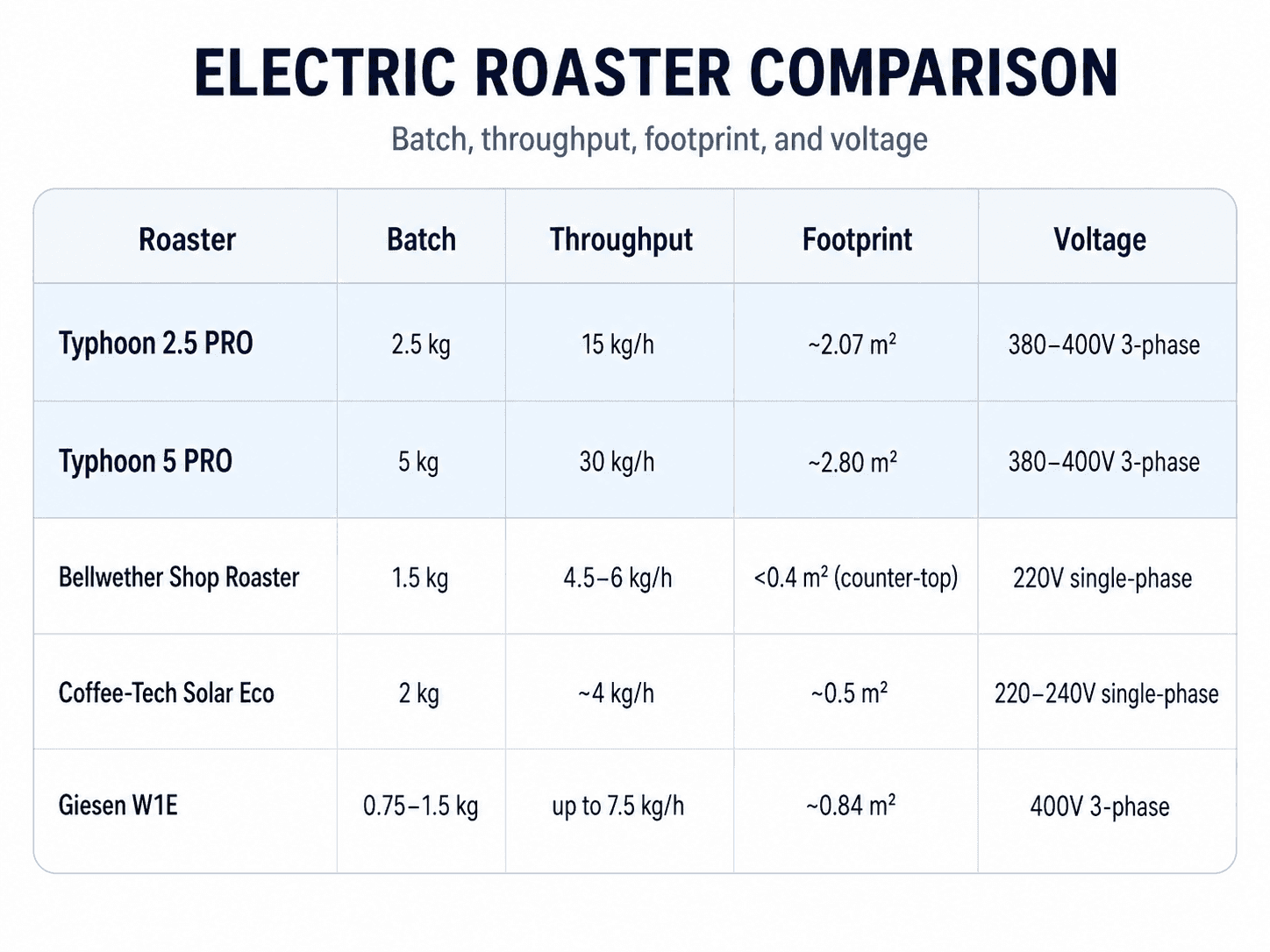
Bellwether Shop Roaster Bellwether:
Batch: 1.5 kg
Throughput: 3–4 roasts/hour (≈4.5–6 kg/h)
Voltage: 220V single‑phase
Footprint: less than 4.5 sq ft counter space
Ventless system with built‑in filtration; marketed heavily to cafés and hotels
Coffee‑Tech Solar Eco Coffee‑Tech:
Batch: 2 kg, fully electric and automatic
Designed for compact shop roasting
Giesen W1E Giesen:
Batch: 0.75–1.5 kg
Throughput: up to 7.5 kg/hour
W1 series includes gas burner options; the W1E is the electric variant
PROBAT BRZ Sample Roaster Probat:
Batch: 80–100 g per drum, 2‑ or 4‑drum configuration
Electric, but intended for sampling, not café production
Bellwether®, Coffee‑Tech®, Giesen®, and PROBAT® are trademarks of their respective owners. Typhoon Roasters is not affiliated with, sponsored by, or endorsed by any of these companies.
Below is a quick comparison focused on café‑scale production.
Compact roaster layout for tight spaces — blueprint essentials
When planning a compact commercial coffee roaster for a small café, layout matters as much as specs. Here’s how to think about your floorplan.
Minimum space and clearances
As a practical rule of thumb, its shop roasters can be installed in as little as 6 m² of floor area. Within that envelope, plan for:
Machine footprint
2.5 PRO: ~2.07 m²
5 PRO: ~2.80 m²
Operator working zone
At least 800–1000 mm in front of the roaster for safe operation and bean discharge
Side clearance (~600 mm) for access to panels and duct connections
Service access
Rear and side access per Typhoon’s installation guide (obtain from Typhoon’s service team)
Height clearance above the hopper and exhaust connection (allow ≥300–500 mm above the stated machine height for ductwork)
Weight & floor loading
Exact machine weights are provided on Typhoon’s shipping documents and technical sheets; urban cafés should:
Confirm floor load rating (kN/m²) with their structural engineer
Verify that staircases, lifts, and doorways can handle the roaster weight and crate dimensions
When in doubt, request shipping weight, unpacked weight, and crate dimensions from Typhoon before finalizing logistics
Example urban installation scenarios
Typhoon lists a variety of compact café‑roastery installs which show what is possible in dense settings Typhoon Clients:
Current Coffee Roasters, Cebu City — café‑roastery in a busy urban environment
Puck Provisions, Singapore — roasting inside a city café with visible equipment as part of the experience
Roastery 29, Sibiu — small European roastery in a compact footprint
Campus Cafe showroom, Paris — demonstration and training roaster in a tight city space
Expe Coffee, Lausanne/Prilly — café‑roastery hybrid in a dense Swiss urban zone
These installations demonstrate that a commercial fluid‑bed coffee roaster for small scale roastery can fit in high‑rent spaces, provided layout and ventilation are carefully planned.
Commercial coffee roaster ventilation requirements in urban buildings
Even with electric roasting, most cities treat coffee roasting as a process that needs controlled exhaust. Understanding the basics will help you design a compliant, future‑proof system.
Typical ventilation metrics planners should know
While exact numbers must come from your mechanical engineer and local code, café owners planning an electric coffee roaster instead of gas roaster should be ready to discuss:
Exhaust airflow (CFM / m³/h)
Many small roasters use exhaust fans in the 500–1500 CFM range (approx. 850–2550 m³/h), depending on batch size and after‑treatment equipment
Typhoon’s specific CFM requirement is listed in its installation manual; request this before MEP design
Duct diameter & materials
Common diameters for café‑scale roasters: 150–250 mm round duct
Materials: galvanized steel or stainless steel, rated for the exhaust temperature and any condensate
Run limits & offsets
Keep horizontal runs as short as practical; many mechanical codes advise a preference for vertical discharge
Limit the number of elbows; each bend adds resistance that must be factored into fan sizing
Maintain required clearance from windows, doors, and air intakes per local mechanical code (often ≥3 m horizontal, or as specified)
Filtration & treatment
Depending on local regulations, expect one or more of:
Cyclone for chaff and particulate
HEPA or multi‑stage filters for particulates and odor
Electrostatic or catalytic systems where ventless or near‑ventless operation is needed
Typhoon’s roasters typically use cyclones and ducted exhaust; the exact configuration depends on model and local requirements. The mechanical drawings supplied by Typhoon include connection sizes and recommended layouts.
Regulatory examples — know your district’s rules
To frame the permitting landscape, Typhoon often references how agencies classify roasting equipment. For example, South Coast Air Quality Management District (South Coast AQMD) in California publishes specific thresholds for coffee roasting operations AQMD Coffee Roasting:
The advisory describes permit needs based on:
Roaster type (drum vs floating‑bed / fluid‑bed)
Batch capacity (lb)
Combined heat input (BTU/hr)
As of the referenced advisory:
Drum‑type roasters with cyclone generally require permits when batch capacity > 18 lb (~8.2 kg) or combined heat input ≥ 1 million BTU/hr
Floating‑bed roasters with cyclone (i.e., fluid‑bed) often trigger permits at batch capacity > 12 lb (~5.4 kg) or combined heat input ≥ 1 million BTU/hr
Natural‑gas afterburners at ≥ 1 million BTU/hr need a separate Authority to Construct
Important caveats:
These thresholds are examples only, specific to the South Coast AQMD advisory; they are not universal rules for all cities
Other regions may have different limits or classify electric roasters differently
Always check your local air quality district, building department, and fire authority for up‑to‑date requirements
Additionally, the International Mechanical Code (IMC) treats the exhaust from coffee roasting under ventilation rules in Chapter 5, typically requiring independent exhaust systems for process equipment. Your mechanical engineer should reference the latest IMC and local amendments when designing your system.
Best electric commercial coffee roaster for specialty café — decision checklist
To select the best commercial fluid‑bed coffee roaster for a small roastery or café, use this practical checklist.
1. Production requirements
Daily roasted coffee volume (kg/day)
Peak hourly needs (kg/h) during busiest days
Future growth (e.g., wholesale or additional cafés)
For most single cafés:
10–15 kg/day → Typhoon 2.5 PRO is usually sufficient
20–40+ kg/day → Typhoon 5 PRO offers more headroom
2. Space and layout
Confirm clear floor area (≥6 m² recommended around the roaster)
Measure ceiling height to allow for ducting above the machine height
Map customer flow so roasting becomes a feature, not a bottleneck
3. Electrical infrastructure
Confirm available 3‑phase 380–400V supply or its local equivalent
Obtain Typhoon’s electrical data sheet for:
Maximum current (A)
Recommended breaker size
Required wiring (phases, neutral, earth)
Verify panel capacity with a licensed electrician
4. Ventilation and permitting
Request Typhoon’s installation drawings for exhaust connection and minimum CFM
Engage a mechanical engineer to size ducts (diameter, length, fan) to local code
Check with:
Local air quality district (for roasting permits)
Building department (for exhaust and mechanical systems)
Fire authority (for process safety and clearances)
5. Support, warranty, and training
Typhoon offers:
2‑year warranty
CE certification on equipment
Complimentary roastmaster training during startup
Remote support and on‑site technicians within 5–10 business days when needed Typhoon Service
This reduces risk compared with buying purely on specs. You’re getting an equipment platform plus a partner in launching your roastery.
Action steps — bring compact electric roasting into your café
If you’re ready to explore an electric coffee roaster for an urban café rather than a traditional gas drum, here’s a concise roadmap:
Define your production profile
Write down daily and peak hourly roast needs
Decide if you will expand into wholesale in the next 2–3 years
Measure and sketch your space
Capture floor area, ceiling height, and nearby walls/openings
Draw a simple compact roaster layout for tight spaces showing the machine, operator zone, and duct path
Collect infrastructure data
Request Typhoon’s 2.5 PRO and 5 PRO spec sheets and installation manuals
Share electrical and exhaust requirements with your engineer
Check regulatory constraints early
Call your local air quality agency and building department
Reference example frameworks like South Coast AQMD but confirm local rules
Talk to Typhoon’s team
Ask for Typhoon coffee roaster installation examples similar to your building type
Review ROI, energy use, and capacity modeling based on 0.3 kWh/kg and your local electricity rate
By following these steps, you can confidently choose a compact commercial coffee roaster for a small café that fits your space, stays compliant, and elevates your brand.
FAQ — compact electric roasters for small cafés
How much space does a compact commercial coffee roaster for a small café need?
Typhoon’s shop roasters are designed to install in roughly 6 m² of space. The 2.5 PRO footprint is ~2.07 m², and the 5 PRO footprint is ~2.80 m², with the remaining area reserved for operator movement, service access, and ducting. Always confirm exact clearances using Typhoon’s installation drawings and your architect’s plan.
Do electric coffee roasters require special ventilation in urban buildings?
Yes. Even fully electric systems generate warm, odorous exhaust that typically needs dedicated ducting, fans, and filtration. Typhoon’s roasters use cyclones and exhaust connections specified in the installation manual; planners must size CFM, duct diameter, and discharge location per local mechanical code and air‑quality rules.
Are Typhoon Roasters more energy efficient than gas drum roasters?
Typhoon reports ~0.3 kWh/kg electrical consumption on its PRO line, based on internal measurements. Many gas drum roasters at similar capacities use burners rated in the 60,000–120,000 BTU/hr range, which often equates to roughly 0.6–1.2 kWh/kg when converted using 1 kWh ≈ 3,412 BTU. That suggests Typhoon’s electric fluid‑bed approach can use about 2–4× less energy per kg, but café owners should request exact energy data from each manufacturer to confirm.
What electrical infrastructure do I need for a Typhoon 2.5 or 5 PRO?
Both models use 3‑phase 380–400V power. You will need a dedicated circuit, properly sized breaker, neutral and protective earth, and allowance for startup current as specified on the roaster’s CE electrical plate and wiring diagram. Typhoon provides detailed electrical documentation; share it with your electrician and engineer before installation.
Where can I see real‑world Typhoon coffee roaster reviews and installations?
Typhoon publishes client stories and installation photos from cafés and roasteries worldwide, including urban sites in Cebu City, Singapore, Paris, Sibiu, and Lausanne/Prilly. These examples show how compact electric fluid‑bed roasters integrate into small cafés and tight urban spaces; you can browse them on Typhoon’s official client page.